


This is Part 3 of a four-part series coming to FET that I hope will become a reference point for understanding key concepts related to housing production.
Why a feasible change of use is different from commercial feasibility
How prices determine the cost of building new homes via choices of density and quality
Housing supply is not new housing production
Why landbanking is a normal market outcome of balancing present and future housing
Interested in learning more? Fresh Economic Thinking runs in-person and online workshops to help your organisation dig into the economic issues you face and learn powerful insights.
If you value this content, please consider signing up as a paid FET subscriber to support this work and get access to all articles and audiobooks.
Another way to help is to share these articles. I am aiming to get to 10,000 subscribers in 2027.
Many non-economists, and frankly, many economists, use the term housing supply incorrectly.
That term supply has a particular meaning in economics.
Supply is a concept representing the willingness of all potential sellers to sell in a period of time. We usually order each seller, or sale, from the lowest price they will accept to the highest price in a list, or schedule.
Or, in other words, supply is an ordered representation of the subjective benefit forgone by all potential sellers. It is always a relative concept—relative to the ordered representation of the subjective benefit of potential buyers.
In asset markets with centralised trading systems, we call the small part of the supply curve that we can see the offer curve. If you want to see supply and demand in action, just look at a depth chart in finance and rotate it 90 degrees, then flip it vertically.
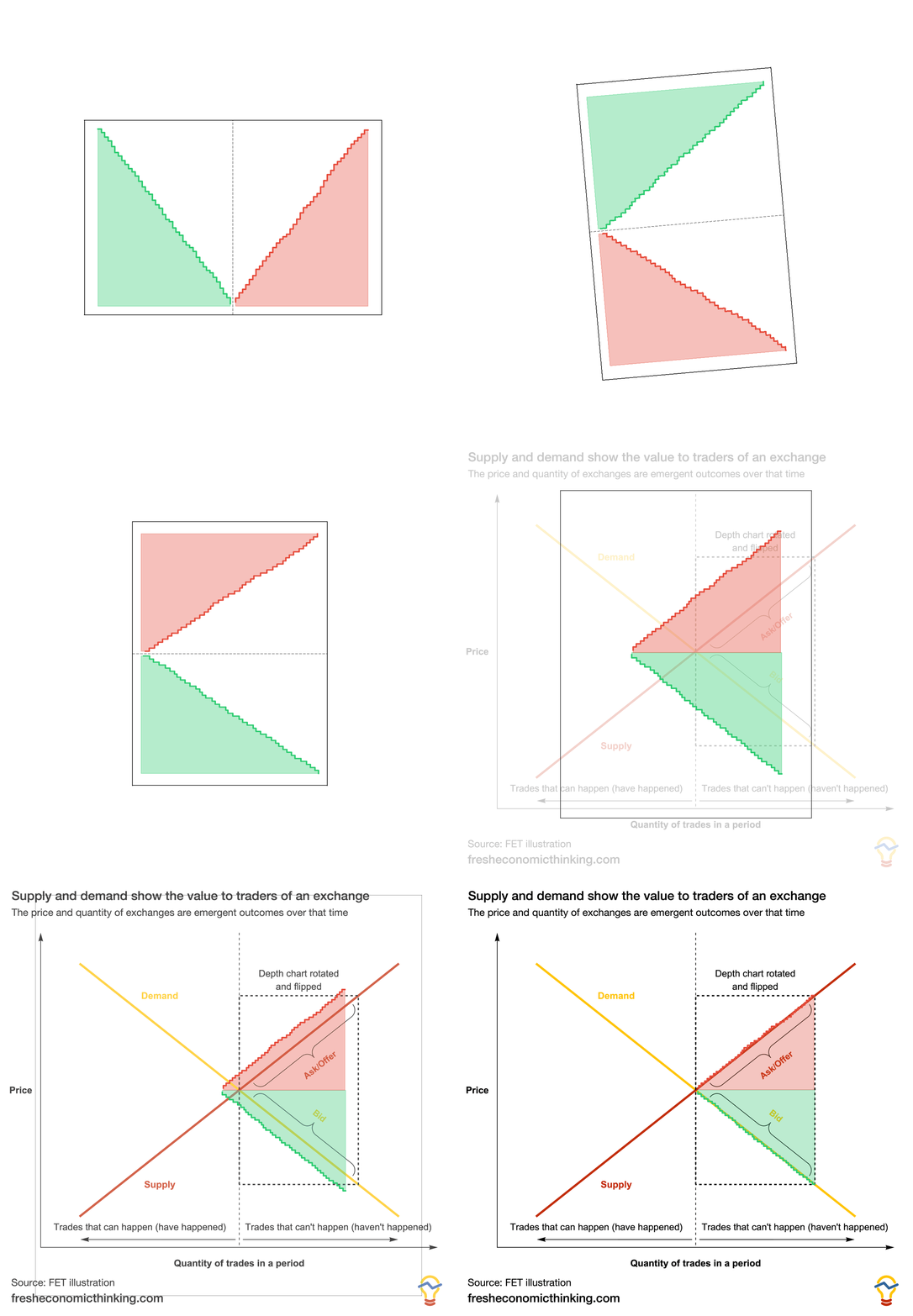
When someone says that the price of CommBank shares, or SpaceX, is determined by supply and demand, they are simply restating the fact that the price is determined by sellers and buyers trading.
The idea that the supply of homes is an important determinant of price is a tautology—after all, what else can determine prices except buyers and sellers interacting in the market?
Supply is an economic concept related to an ordering of potential sellers by how much they will accept to trade and forgo the benefit of owning the thing until the next opportunity to trade (i.e. their benefit to waiting).
For newly-produced goods and services, it is usually because of specialisation and capital investment that producers are willing to accept a lower price than buyers are willing to pay—the benefit of them holding on to a good until the next period is low because they will produce more goods next period too.
Things that aren’t housing supply, but are often called supply, include:
I had put the paywall here, but decided it was more important that these ideas were widely read. If you get value from the rest of this article, please consider becoming a paid subscriber.
The stock of homes
The cost of housing construction
The amount of development-feasible capacity
The number of new homes built in a period of time
These are not supply. But they are an emergent market outcome of the interaction of supply and demand (i.e. buyers and sellers) on a variety of trading dimensions.
For example, the quantity of homes traded within a period of time is the emergent outcome of the interaction of willing sellers who will accept a price lower than what willing buyers are willing to pay, for both new and existing homes.
Why does all this matter?
Because the idea of reducing the price of homes by engineering some kind of policy effect on supply dominates our housing policy debates.
It is both true and tautological that if sellers were suddenly willing to sell for lower prices, holding demand fixed, more trades would happen and prices would fall.
Unfortunately, little attention is given to the practicalities of housing markets, where most potential sellers are owners of the existing housing stock, and where the willingness to sell and buy do not move independently, but jointly based on the expectations of all market participants, like in other asset markets.
Common “supply” errors
Before we dig further, I want to note a few errors I see when discussing housing supply. The first is thinking about supply in physical rather than economic terms.
Our brains excel at navigating the physical world but are quite poor at conceptualising deeper emergent concepts like market interactions.1 When we are in the physical thinking realm, we start looking for spaces to put homes, such as air rights above buildings, and physical ways to build houses differently, like pre-fab.
“If only we had more physical things”, we think.
But we have a value problem much more than a physical problem—a value of investing in new homes over alternatives. It reminds me of solar roads, which became a thing because of reasoning physically about needing more space for solar, rather than economically about the trade-off between the benefits of alternative uses of space and the benefit of solar power versus alternatives.
Another common error is to deny that supply exists or to claim that “demand and supply don’t apply to housing and land”.
They do. They must.
Sure, these concepts are often applied inconsistently, without recognising the full opportunity cost of potential sellers (the benefit they get from waiting) or the relevant trading dimensions. In a previous three-part FET series, I explained much of this nuance.


Indeed, in housing markets the supply and demand of trading opportunities lead to emergent outcomes across many different dimensions.

Back to supply
Who are the willing sellers of homes?
In Australia, they are the owners of the 11 million existing homes, plus the owners of development-feasible sites who can sell new homes.
Most housing trades are for existing home sales, soaking up the supply from these owners, with relatively little of the overall market supply being from new homes.
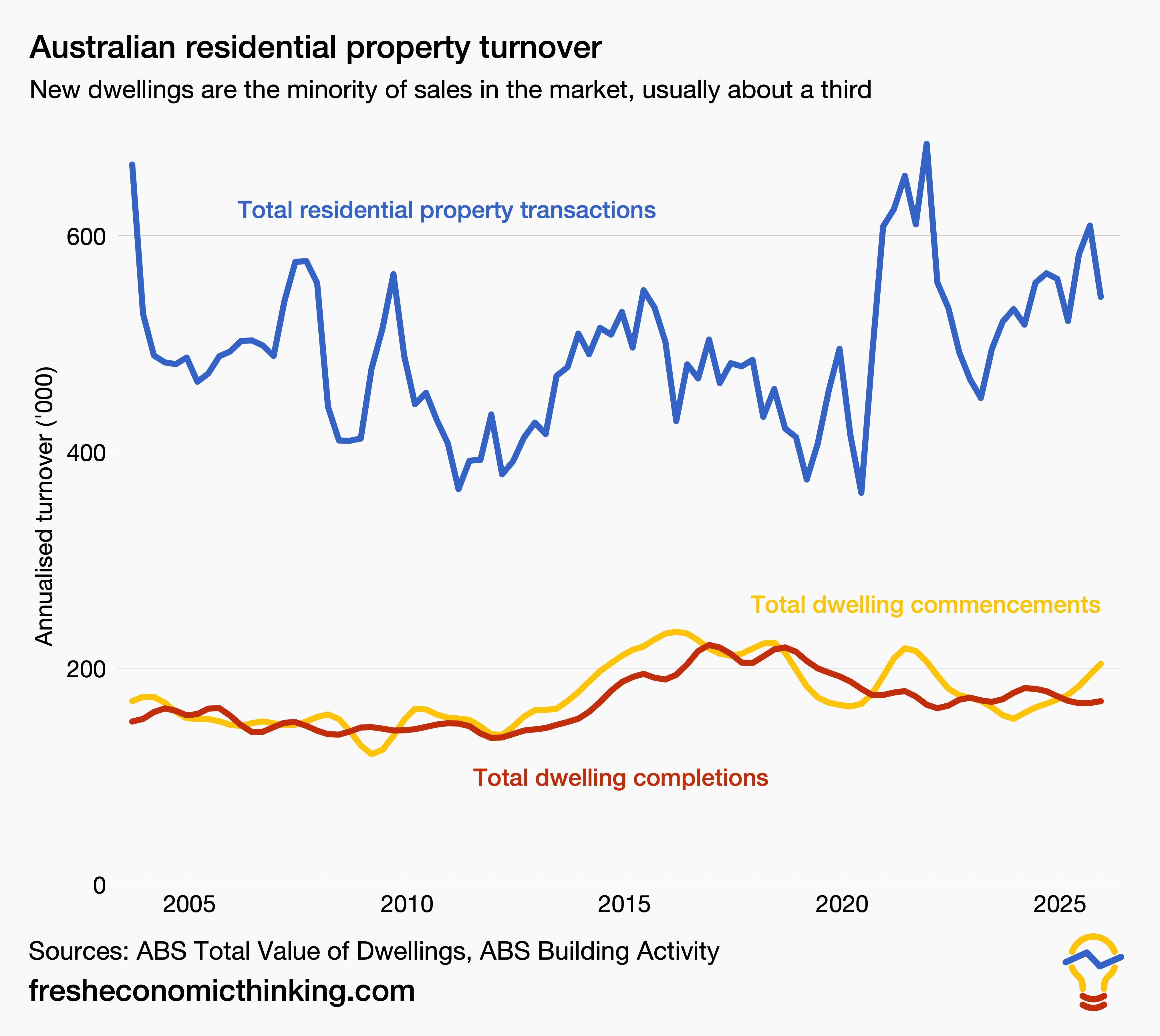
Below is a plot of the total property transactions versus the number of new dwellings in Australia. Less than a third of housing transactions are new homes, meaning that most of the market supply is existing homes.
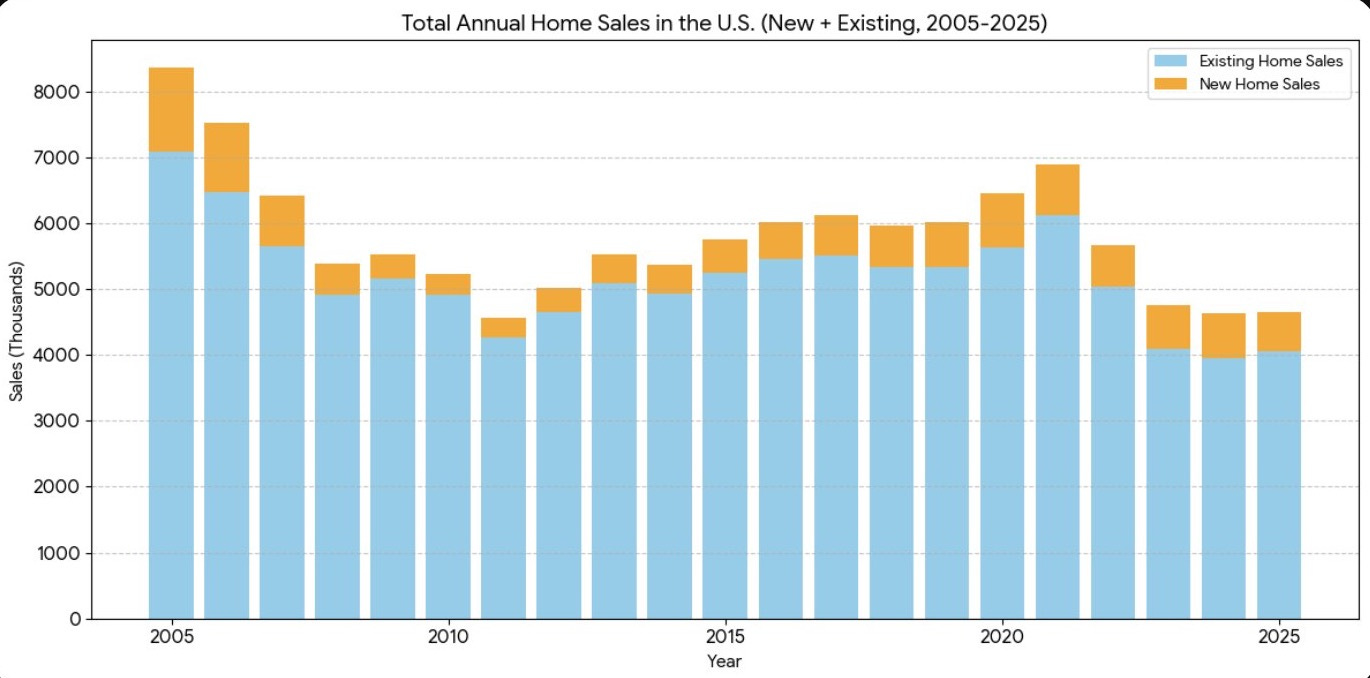
In the United States, the stock of existing dwellings is much larger and growing more slowly, so almost all housing trades are existing homes.
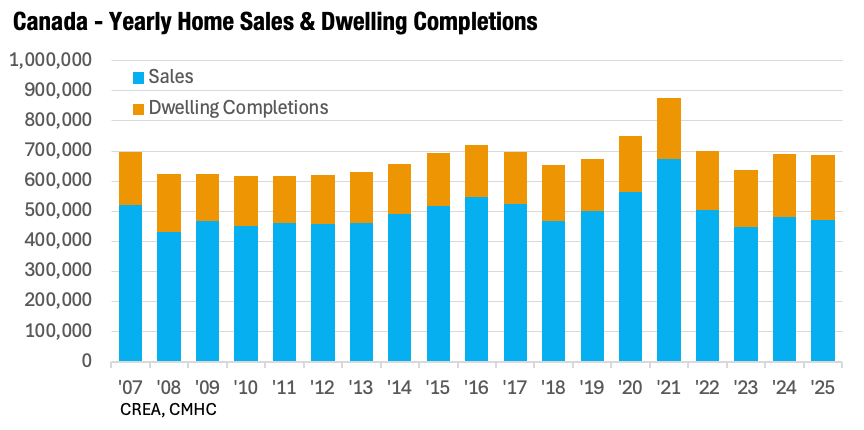
Here’s the data for Canada, showing a similar share of new home trades compared to existing trades as in Australia.
The lesson here is that a change in housing supply (i.e. willingness to sell) that has a substantial effect on the market price of homes will predominantly come from the much larger pool of potential sellers of existing homes than new homes.
If the 11 million owners of existing homes decide they prefer owning non-housing assets instead (including cash), they reduce the price they require to sell now. Another way to describe this is that potential home sellers increase their demand for money relative to their demand for homes.
This increases housing supply (i.e. a sudden rightward shift in the supply curve).
We have a name for this—a market crash or correction. This is what increasing housing supply usually looks like in reality.
And generally we think this is bad.
One reason it is bad, beyond the price change, which will be bad for sellers and good for future buyers, is that demand and supply are both determined by common factors in asset markets rather than being independent.2 If sellers suddenly decide that money is better to hold now rather than homes, many potential buyers will also think that.
If you lived through the financial crisis in Ireland, Spain or the United States, you would recall the housing market feedback process of a greater willingness to sell across all sellers, but falling willingness to buy. The net result was that prices fell substantially, but with much fewer trades. Turnover fell from 6.5% per year before the financial crisis in the United States to 3.5% per year during and after it.
This non-independence is also why emergent pricing in share markets is rarely analysed in terms of supply and demand, and more in terms of overall return expectations of all market participants, buyers and sellers alike.
Supply and demand are also tied together by common factors when prices are rising.
When potential buyers increase their willingness to buy, shifting demand rightward, some potential sellers will also change their willingness to sell for the same reasons. If buying a home suddenly becomes a good investment and buyers notice, potential sellers will recognise that too and no longer accept the previous lower prices they were willing to.
Combining the ideas that 1) supply is the willingness to sell now rather than hold, 2) most potential housing suppliers are owners of the existing stock, and 3) that demand and supply in asset markets are not independent, leaves us in a predicament when translating the policy intent of “supply more new homes to bring down prices” into practice.
Is it even possible to orchestrate a policy shift such that only sellers of new homes become impatient and willing to accept lower prices, while buyers and sellers of existing homes stay patient and are willing to pay and accept higher prices?
It seems a stretch to me. And only thinking clearly about supply helps identify this predicament.
As always, please like, share, comment, and subscribe. Thanks for your support. You can find Fresh Economic Thinking on YouTube, Spotify, and Apple Podcasts.
It took me years to stop thinking physically and start thinking economically. You might have caught me years ago saying things like “there is no such thing as exponential growth in a finite world” because of my ape brain. Now? I can separate the concept of value and exchange and the exponential growth in these economic concepts from the physical nature of Earth.
In the strictest sense, the curves as they exist at a point in time are independent. For example, the same people offering their company shares or stocks for sale in a period are generally not also bidding to buy them back immediately at the same price. There are two independent groups of people making up the supply and demand curves at each point in time.
you are 100% right, building homes has very little to do with housing supply and even less with changing supply-demand balance
It should also be pointed out that equally, housing demand has very little to do with demand for homes as places for living
It all comes from the fact that housing is a natural monopoly (even in the most construction liberal places)
Great perspective, Cameron. I never thought of housing supply in these terms.
Intuitively, I still think there is more to solving that puzze. Like, in physical terms, how about renting vs. buying? Why some people "sacrifice" their lifestyle and rather than trading their house, opt to buy one for renting to others? Why some locations have excess supply while others excess demand that can only be fulfilled at much higher price? Etc.