


This is Part 2 of a four-part series coming to FET that I hope will become a reference point for understanding key concepts related to housing production.
Why a feasible change of use is different from commercial feasibility
How prices determine the construction cost of building new homes via choices of density and quality
Housing supply is not new housing production
Why landbanking is a normal market outcome of balancing present and future housing
Interested in learning more? Fresh Economic Thinking runs in-person and online workshops to help your organisation dig into the economic issues you face and learn powerful insights.
If you value this content, please consider signing up as a paid FET subscriber to support this work and get access to all articles and audiobooks.
Another way to help is to share these articles. I am aiming to get to 10,000 subscribers in 2027.
In Part 1 of this FET article series, we defined the terms commercial feasibility and change-of-use feasibility. While doing that, we took as given the density and quality of a housing project to be the one that provides the highest residual value for the property owner today.
But as noted, the highest-value use might be future development, and the project's density and quality might look very different at that future time.
The purpose of this Part 2 is to explain how the choice of density and quality is caused by the market price, and hence, so too is the construction and development cost of homes caused by the market price.
Too often, we get this causality backwards.
We think that construction costs drive home prices; hence, reducing construction costs is a way to make homes cheaper. It will certainly make homes bigger, denser, and better. But not cheaper.
Property industry lobbyists claim that causality runs from cost to price, starting with land costs paid, and adding on all other costs (e.g. p10 here). If home prices are caused by the sum of costs, then adding costs makes housing more expensive.
This sounds intuitive.
But it’s wrong.
Indeed, one of the puzzles in recent years has been the shift towards lower-density, but more luxurious, high-quality apartments. But if construction costs are rising, you build smaller dwellings, not bigger ones, right?
Here’s the thing.
Average home prices are determined by overall asset markets, rent levels by renters' incomes, and rental variation across locations by differences in quality of life.

As we will see, when the price of homes rises, it changes the choice of density and quality of homes, justifying spending more on construction costs per dwelling to maximise returns.
The fact that the total land and development costs of a housing project are roughly equal to the price is just an equilibrium outcome about the choice of project and the way land value is derived.
Causality runs from market prices to the choice of density and quality, then to the cost (i.e. how much is spent per dwelling) of housing construction and development.
Developers choose what density and quality of homes to build on a site, and this choice determines both revenue and costs.
Home prices can’t be determined by cost, since the cost of producing a $1 million home is very different depending on the density of that home. A small budget house that costs $200,000 to build could sell for $1 million at the right location, or a fancy apartment in a CBD tower that costs $900,000 to build might sell for $1 million.
Which of these costs determines the price?
Abstracting away from the choice of density and quality makes it impossible to understand housing markets and housing development. There is no such thing as the cost of developing a new home. But there is such a thing as a massive range of costs to develop new housing of different densities and qualities.
Let’s take a look.
Adding density and quality choice to our analysis
The trick to understanding the choice of density and quality of a housing project is to recognise that there are construction diseconomies of density. It costs a lot more to build a dwelling with the same market value in a denser project.
Because costs rise with density, high-density housing is only the optimal choice in high-priced locations and at high-priced periods of time. High prices themselves lead to the choice of building higher-cost housing density and quality.
The table below illustrates this point.
I had put the paywall here, but decided it was more important that these ideas were widely read. If you get value from the rest of this article, please consider becoming a paid subscriber.
The numbers are somewhat arbitrary, but they demonstrate clearly the economic relationships.
The top section of the table shows the density alternatives, the development cost per dwelling (for a dwelling with an equal market price in each project), and the number of dwellings in each alternative project design. The detached home has a construction cost of $500,000, but a dwelling in a high-rise tower with 120 apartments that sells for the same price would cost $950,000 per dwelling to construct.
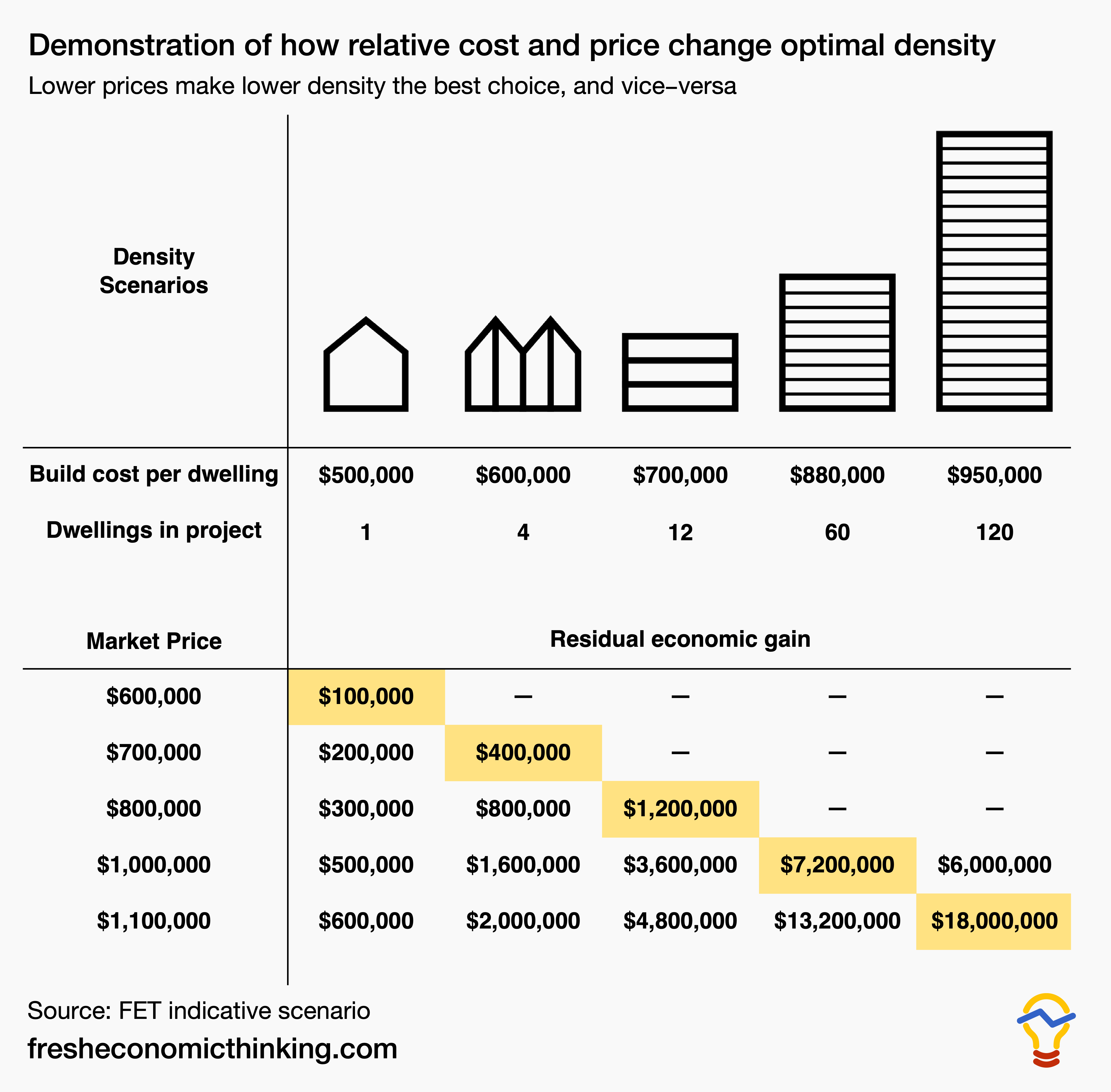
The bottom part of the table shows the residual economic gain, which is the revenue minus the cost of each density project under different market price scenarios ranging from $600,000 for this dwelling to $1,100,000.1
At a market price of $600,000, only the single house is a change-of-use feasible development, with a price above its development cost.2 Building four townhouses is not, as they cost $600,000 each to receive the market price of $600,000. You are better off building one house instead. In fact, none of the higher density options provides a positive residual gain at this market price, as the cost per dwelling is higher than the price.
Notice that as the market price rises, the situation changes. The biggest gain for each market price scenario is highlighted in yellow.
At a market price of $700,000, building one detached house for $500,000 leaves you with $200,000. But building four townhouses for $600,000 each leaves you with $400,000. At this slightly higher market price, you are better off choosing the higher-density townhouses, even though they have a higher cost per dwelling to develop.
As the market price rises further to $800,000 per dwelling, you can still make money with a single house. Spend $500,000, and you have a $300,000 residual gain. You can also make even more money with townhouses, with a $200,000 margin on four of them for an $800,000 residual gain,
But now, 12 apartments leave you in the best situation.
The price is high enough to justify spending $700,000 per dwelling on development costs, and because there are now 12 dwellings with a margin on each of $100,000, you get a $1,200,000 residual gain.
We can see the pattern. Rising prices justify higher densities, even though they also increase the economic gain from developing at the same density.
The same is true for quality choices. Rising prices relative to cost justify improving the quality of housing in all aspects, from kitchens and bathrooms, appliances, to the quality of building common areas, to carparks and storage, to balconies and more.
Rising prices relative to construction and development costs change the choice of density and quality of homes more than the overall quantity. This is why thinking that some new, cheaper construction technology will mean more homes is mostly wrong—it will mean building bigger, better and denser homes. This is good and desirable. But it is a different outcome.
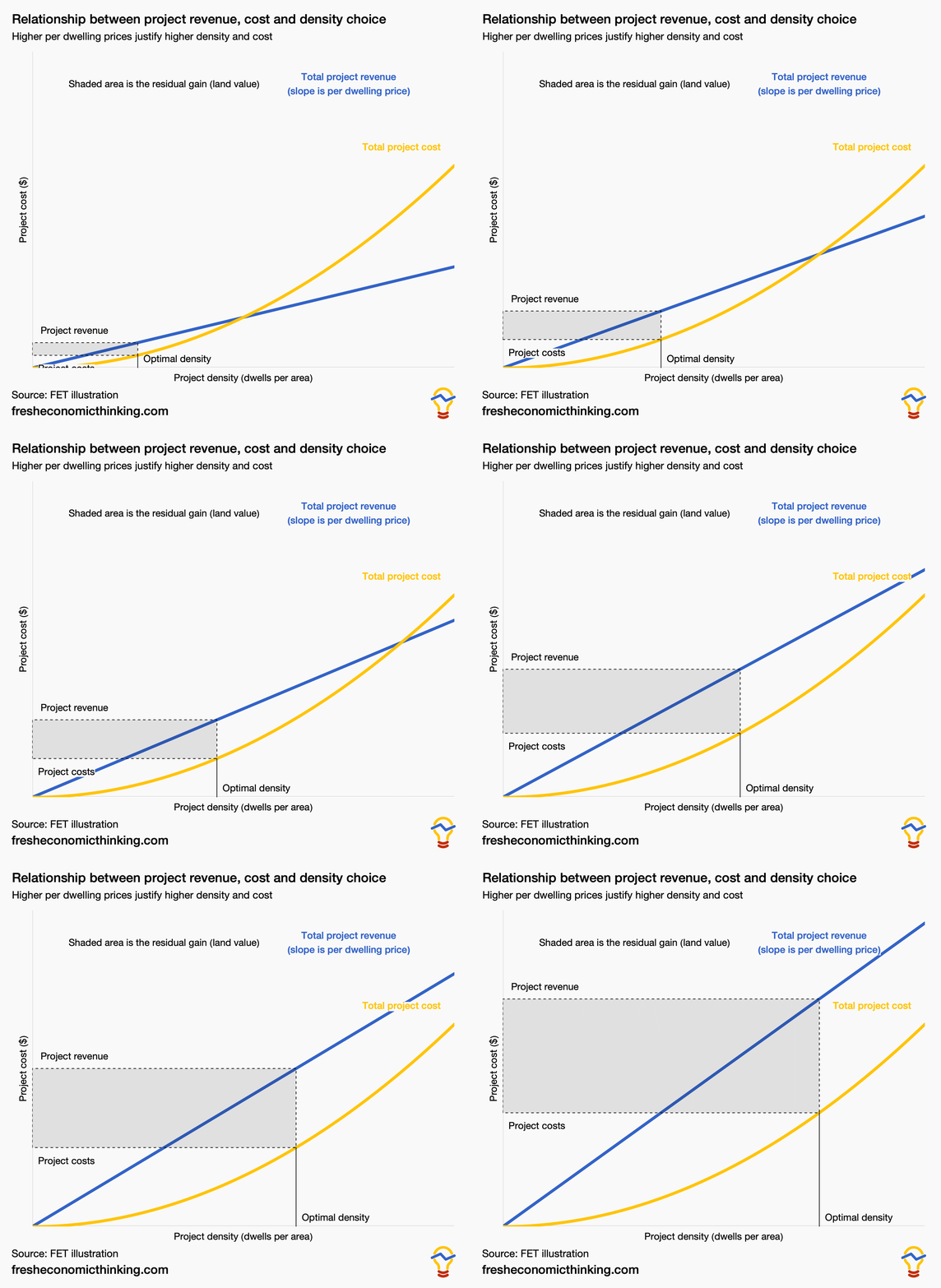
For those who love an economic chart, here is an animation of the choice of density at different market prices. The slope of the blue line is the market price of a dwelling, which hence determines the total project revenue at different densities. The yellow line is the total project cost at different densities, with the curve arising due to diseconomies of density.
As the market price rises (i.e. the blue line gets steeper), the optimal density choice increases, dragging up the total cost (and hence per dwelling cost too). Spending higher costs at higher prices is what provides the highest total project residual gain (the shaded area).
So what?
This might seem straightforward, but understanding how market prices relative to construction costs change density choices really matters for understanding the housing market.
In our example, rising prices led to the choice to build dwellings at a density that was more expensive to build. At a market price of $600,000, it was best to choose to spend $500,000 per dwelling on construction. But a 67% market price increase (relative to construction costs) meant a mid-rise apartment project was the best choice, even though the cost per dwelling was 76% higher than the cost of the detached home (at $880,000 per dwelling instead of $500,000 per detached house).
Along the highlighted diagonal of optimal density choices, development cost was always between 83% and 88% of the market price. It never fell.
So construction costs can’t determine prices. They can’t. Construction costs were 83% to 88% of the market price at all market prices because costs follow prices.

This example also helps us see what happens when prices fall relative to construction costs (from either rising costs or falling prices).
For example, instead of making $7.2 million on a mid-rise apartment project when the market price per dwelling is $1 million, a price decline of 20% to $800,000 means that the best possible project is now a small walk-up apartment block, which makes only $1.2 million, or an 83% decline in residual gains.
This enormous volatility arises because the residual gain to the property owner is a leveraged exposure to housing prices, as I explain here.

Notice that at higher market prices, the often-desirable middle densities are less economically advantageous than the higher densities. So to get those middle densities requires a market price high enough to justify them, but not too high that even higher densities offer a better residual gain. Or, they require preventing even higher densities in high-priced locations.
This relationship between market price and optimal density choice has long been known.
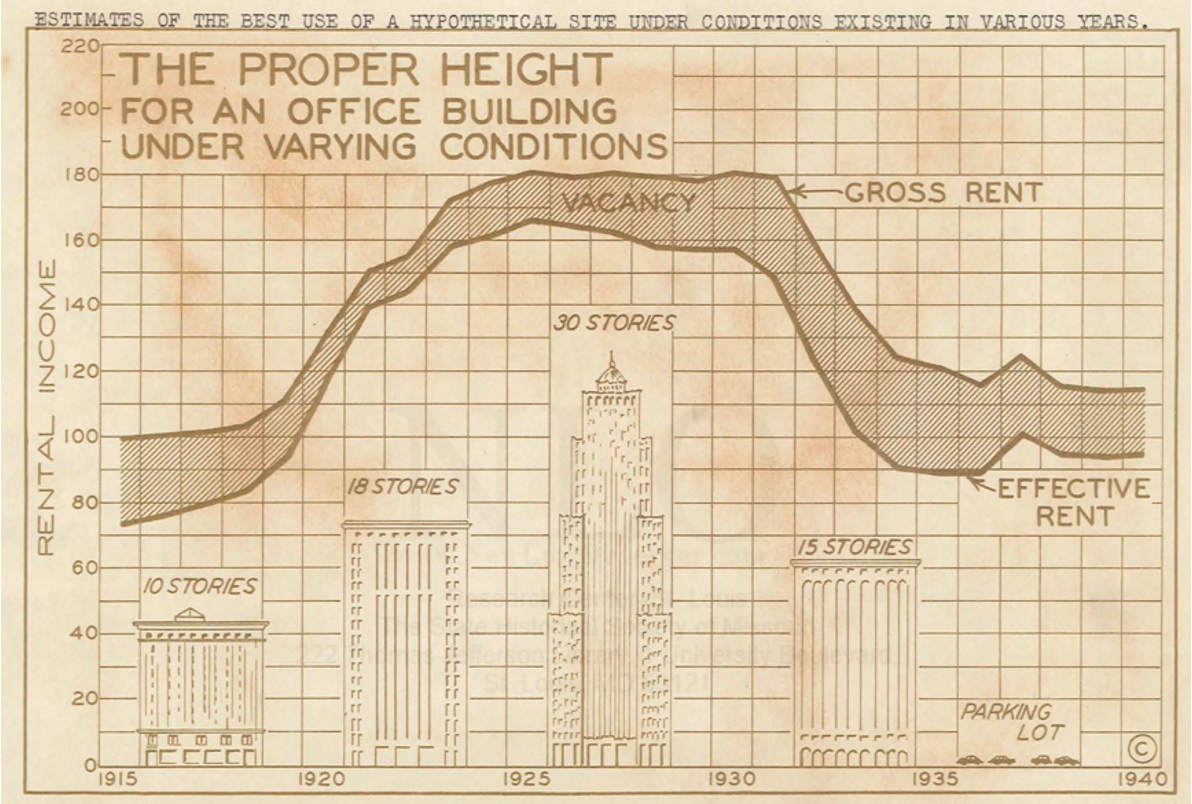
Here’s an image from Roy Wenzlick’s 1942 thesis on the Fluctuations of Urban Rents, Their Causes, and Implications. He clearly notes how rising office rents justify higher density. But when rents fall, the optimal density choice falls too. Even though offices are still development-feasible at these new lower prices, the same density is no longer the highest value use.
It was also the case that construction technology changed substantially during the 1920s, which allowed for much higher density without as much added cost. The combination of higher prices and falling construction costs (i.e. much higher market prices relative to construction costs) is why, in the highest-value locations of the period, the world’s tallest (densest) buildings were developed—the Chrysler and Empire State Buildings.
As always, please like, share, comment, and subscribe. Thanks for your support. You can find Fresh Economic Thinking on YouTube, Spotify, and Apple Podcasts.
It is important to remember that what matters here are the prices of development and housing assets relative to each other, not the nominal values.
Let’s also simplify by assuming we are dealing with a vacant site that generates no income from its current use.
you are 100% right that high prices make homes more expensive and not the other way around
there is another unintuitive thing happening: higher prices cause more construction
God Bless Cameron. Doing God’s work. Go here to get the March 10, 2026 Palo Alto Policy & Services Committee staff report. First, be careful. It’s a huge packet in a single .pdf. No I'm not spamming the site. But know that this is a .pdf download not a web site.
https://cityofpaloalto.primegov.com/Public/CompiledDocument?meetingTemplateId=18366&compileOutputType=1
Item 2 is a staff report and economic study to determine where multi-family housing is feasible and/or where it could be made feasible as a matter of policy. The staff report precedes the EPS economic study in the packet.
The study uses an RLV methodology, and makes findings that make me and Cameron grin. Office is usually always the so-called highest-and-best-use. Where housing is the clear winner, it is for lower density housing ("townhomes.") Mult-family housing comes in third. (Table 8).
The pro formas for real sites are also vetted by local developers. These outcomes are not applicable to every real sub-market of every city, but this confirms that the methods, and analysis Cameron is using are real and valid, and sometimes non-intuitive outcomes are still so-called "highest and best use."