

This is Part 1 of a four-part series coming to FET that I hope will become a reference point for understanding key concepts related to housing production.
Why a feasible change of use is different from commercial feasibility
How prices determine the construction cost of building new homes via choices of density and quality
Housing supply is not new housing production
Why landbanking is a normal market outcome of balancing present and future housing
Interested in learning more? Fresh Economic Thinking runs in-person and online workshops to help your organisation dig into the economic issues you face and learn powerful insights.
If you value this content, please consider signing up as a paid FET subscriber to support this work and get access to all articles and audiobooks.
Another way to help is to share these articles. I am aiming to get to 10,000 subscribers in 2027.
What do we mean by feasible new housing?
The word feasible gets used in two ways. We should have two words.
First, the word feasible gets used to mean that the development of new housing today would provide a larger residual income stream to a property owner than the current use. Let’s call that change-of-use feasibility.
Second, the word feasible gets used to mean that buying a site today at the market price and building new homes today can be done in a way that provides a return on costs that exceeds the risk taken. Let’s call that commercial feasibility.
In a recent FET article, I explained how commercial feasibility can never be found—the price of land will ensure that, at best, new development profits reflect the risk that developers in the market would be willing to take. Commercial feasibility gets bid all the way down to zero via rising land values, such that development returns only reflect risk.
And yet, this concept is widely thought to be very important for town planners and policymakers to try to measure and target via policy.
Let’s use the diagram below to illustrate the difference between these two feasibility concepts.
The first column in light red represents the present value of the income stream of the current use of a site. This could be zero in the case of a vacant or empty site.
The next column is the total revenue from the development project of a design and density that, if undertaken today, would lead to the highest residual value after development costs and a margin that reflects the risks taken.
The third column shows the breakdown of how that revenue generates the maximum residual (yellow) after subtracting development costs (blue) and a margin that reflects the risk taken to complete the project (grey).
That also happens to be the minimum value of that land, or site, today.1
At that land value, the project is just barely commercially feasible for the most optimistic developer who thinks they can best manage costs and risks and design the project with the highest residual income.
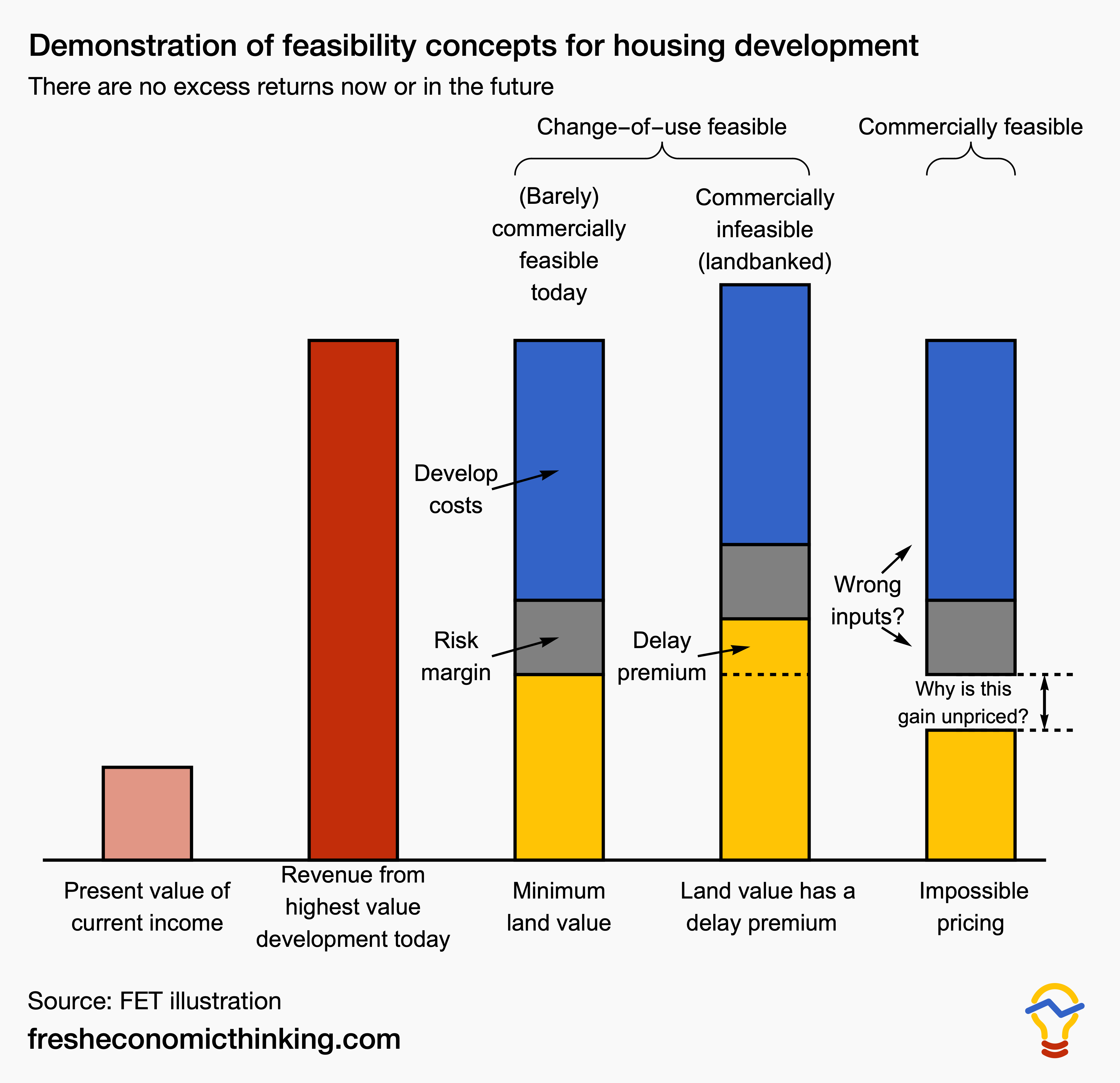
Note that the land value (yellow) is higher than the present value of the income of the site in its current use (the light red first column). This scenario meets change-of-use feasibility, meaning that the value from development today is higher than the value of never developing and retaining the current use.
But the fourth column shows another scenario.
Here, the land is valued higher than what is needed to make the site barely commercially feasible today, and hence the project is commercially infeasible today. I have labelled the extra land value a delay premium.
This situation arises because property owners have more than two options: never develop or develop today. They can also develop at some point in the future. And since all expected future economic returns are priced in by traders today, buyers will often pay more for a site than it is worth for development today only. They pay a premium for the possibility of even higher gains from developing in the future.
The market of buyers and sellers of sites will sort out via their trades which sites are expected to be best to develop now, and which are best to develop later, and this will be reflected in the pricing of those sites. And indeed, the return from waiting to develop will, even at this higher starting price, reflect the risk taken and the rate of return in a market equilibrium. Waiting also pays. As it must.
For completeness, the final column shows the scenario of a clearly commercially feasible site, where the land, development cost and risk sum up to less than the revenue from the best project today. But since markets price in all risks and returns, land simply cannot trade at this low price and leave excess returns on the table, as I previously explained here.
These conceptual distinctions matter for policy design and analysis.
Many policy changes in recent years have been motivated by the idea of creating more feasible housing development sites. But the feasibility concept often being inadvertently applied is one of commercial feasibility, which we know cannot exist on average in a market.
We can’t create excess returns. They get immediately priced in via higher land prices.
Where the more appropriate change-of-use feasibility concept has been considered, it has usually been done without recognition that the market will sort sites into those best to develop today or in the future, and it will do this via pricing expected future gains. Adding more sites to a large pool of sites with feasible changes of use will simply cause them to be priced in a way that reflects that the highest-value use is development in the future, meaning that they remain commercially infeasible, but at a much higher land value.
Using two terms to ensure the two distinct meanings of feasible housing are used consistently is a first step toward building a sensible understanding of why and when new homes are built.
As always, please like, share, comment, and subscribe. Thanks for your support. You can find Fresh Economic Thinking on YouTube, Spotify, and Apple Podcasts.
This is called the value matching condition of real options theory—i.e. the value of the site undeveloped is the same as the value of the site when developed, and it is the minimum value a site can take. An undeveloped site will always have a value at least as high as the value derived from building today. This review article is useful for those wishing to dig deeper.
"The first column in light red represents the present value of the income stream of the current use of a site. This could be zero in the case of a vacant or empty site."
Isn't it going to be negative because of the associated costs of ownership / rates?