

This is Part 4 of a four-part series coming to FET that I hope will become a reference point for understanding key concepts related to housing production.
Why a feasible change of use is different from commercial feasibility
How prices determine the cost of building new homes via choices of density and quality
Why landbanking is a normal market outcome of balancing present and future housing
Interested in learning more? New workshop dates for Sydney and Melbourne have just been released for mid-November 2026. Click the images below to book your tickets at Eventbrite.


If you value this content, please consider signing up as a paid FET subscriber to support this work and get access to all articles and audiobooks.

In Part 1, we looked at change-of-use feasibility versus commercial feasibility.
In Part 2, we looked at how higher home prices lead to higher construction spending on each new home via the choice of density and quality.
In Part 3, we looked at housing supply as a concept of trade, not production.
Now, in this final Part 4, we look at the housing production rate (i.e. new homes produced per period of time). This is also known as the absorption rate, or build-out rate, and is often wrongly called supply.
As a primer, you can take a look at this FET article.

Here, I want to try to explain the economics of the emergent market production rate of housing by doing something a little different.
Instead of starting with the question “Why are homes built?”, I will start with the question “Why are homes not built?”
It is common to own a site with a feasible change of use and not develop new housing (or any other type of feasible use, like retail or commercial buildings) on it today. This is why the distinction between change-of-use feasibility and commercial feasibility in Part 1 of this FET article series was so important.
Outside of a handful of academics who take the questions of timing and irreversibility of investment in the real options literature seriously, there is almost no attention given to the optimal timing of new housing. It is merely assumed that every landowner is in a hurry to build any feasible change of use instantly, and that any waiting creates a huge cost for them.
This has led to a contested debate about the concept of landbanking.
This real, observable phenomenon gets denied or redefined rather than grappled with. Below is a video of a property investor describing clearly the economic logic of delay. He notes (in his terminology) how sites that are change-of-use feasible are generally not going to be commercially feasible for many decades until population growth patterns change the waiting calculus. In another video, the same property investor explains how the highest and best use can be to hold change-of-use feasible sites rather than develop today.
Before outlining the limited academic and policy debate about landbanking, I will be clear that I define landbanking as the existence of a large pool of sites with a feasible change of use that are not currently developed for that use.
Landbanking is just the name we give to the fact that not every feasible change of use of property to housing is developed the moment it becomes a feasible change of use.
It is true that most landbanked sites are not commercially feasible. But commercial infeasibility is an emergent pricing outcome that arises for the sensible economic reason that building in the future is what traders in the market expect to generate the largest economic gain. And it is this definition that is clearly a real phenomenon that needs a coherent economic explanation.
Implicit acknowledgments of landbanking by those who deny it
In a 2015 inquiry into land use, the New Zealand Productivity Commission grappled with the issue. Many submitters raised the topic. The New Zealand Transport Agency (NZTA), for example, submitted that “land banking is an issue where developers may drip-feed zoned land on to the market to maximise the value of new sections”.
But since then, many individuals and organisations have denied that landbanking of change-of-use-feasible sites exists. This is what Australia’s Productivity Commission wrote in 2022 (pp. 468- 469):
Landbanking is a theory that the supply of housing is constrained by developers withholding land from the market to drive up prices.
Okay. And then.
Landbanking also requires developers to believe that they can ‘time the market’ — in other words, sell properties when prices are high and hold onto them when prices are low (which would be easier if theyhad the ability to influence market price). And it requires a general belief that property prices will perpetually rise — if the market price is constant or declining over time, there is no benefit from withholding land from the market.
A big claim here is this one.
Landbanking theories also cannot explain why the examples of zoning reform listed above led to greater housing supply.
A critique of an FET article about the methods of analysis of Auckland’s upzoning laid out the denial case by noting that “developers aim to maximize profits, not maintain prices” and that “[m]ost economists tend to dismiss such ideas”. They note that:
The small number of existing studies are limited by a lack of data on developers’ cost structures, which prevents them from ruling out that delayed construction or large “land banks” are driven by factors like managing dynamic production costs (e.g., labor constraints, material price fluctuations) or attempts to smooth costs over time.
It has become a very strange debate.
The craziest part is that those who deny that landbanking is real also imply that it is a necessary part of a normal property market when they seek to upzone to create enormous amounts of change-of-use feasible new housing, knowing that only a tiny fraction will be built on even after decades.
For example, here is an article reporting an analysis of how many new townhouses could be built under changes to zoning in Australia’s capital cities. The key part is in the image below.
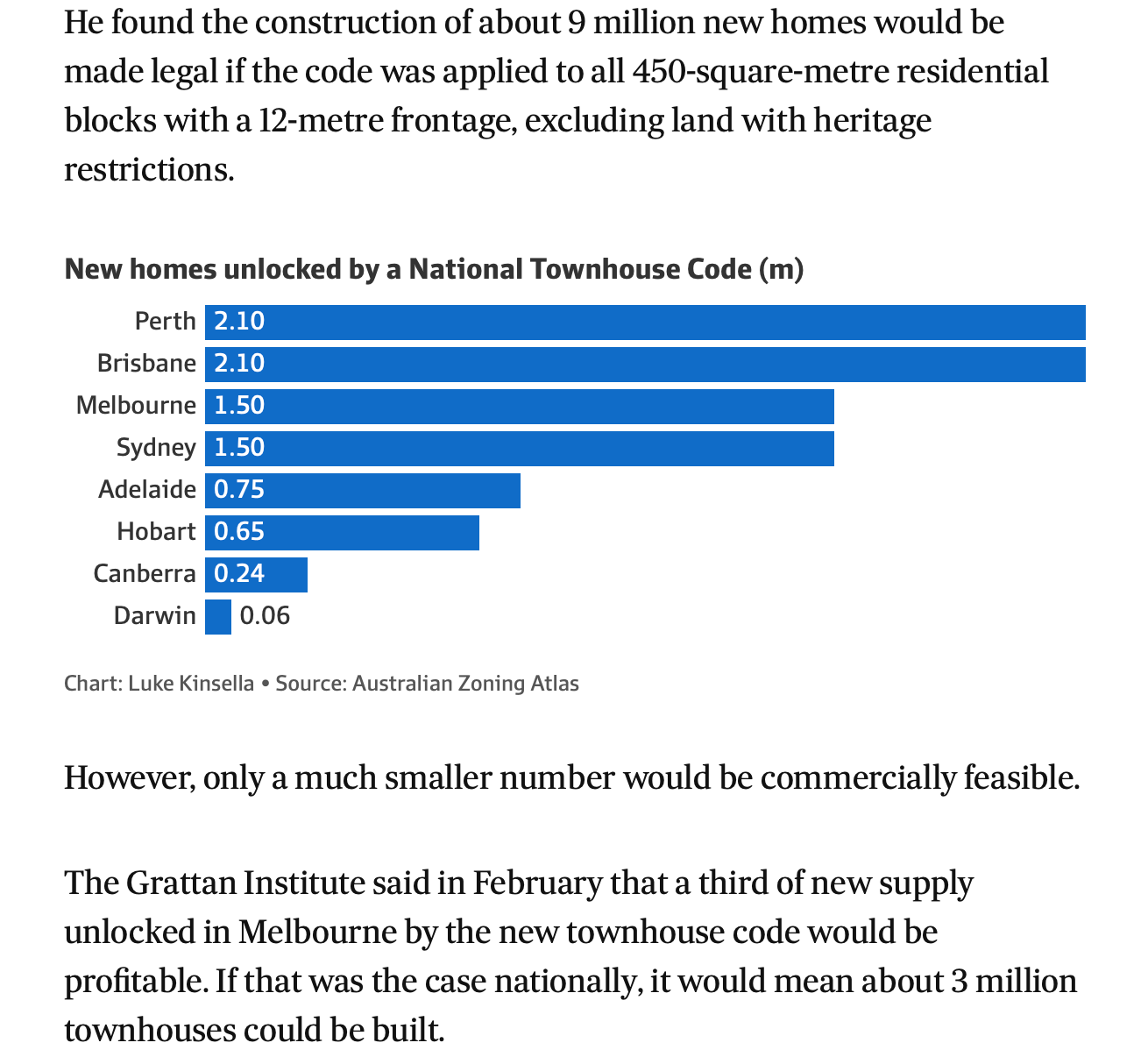
The claim is that 9 million new homes would be unlocked in cities with a current housing stock of less than 8 million homes, and that 3 million will be immediately profitable (i.e. change-of-use feasible). If you think landbanking is not real, then all 3 million townhouses should be built immediately.
Of course we all know that won’t happen.
Less than 200,000 new homes of all types are built each year nationwide. No one truly thinks that the rate of housing production will increase by a factor of ten because of a rush to build these homes instantly. Almost all of them will be landbanked instead and held for development at a future time.
It is now the norm to deny landbanking, then assume that most feasible sites are landbanked.
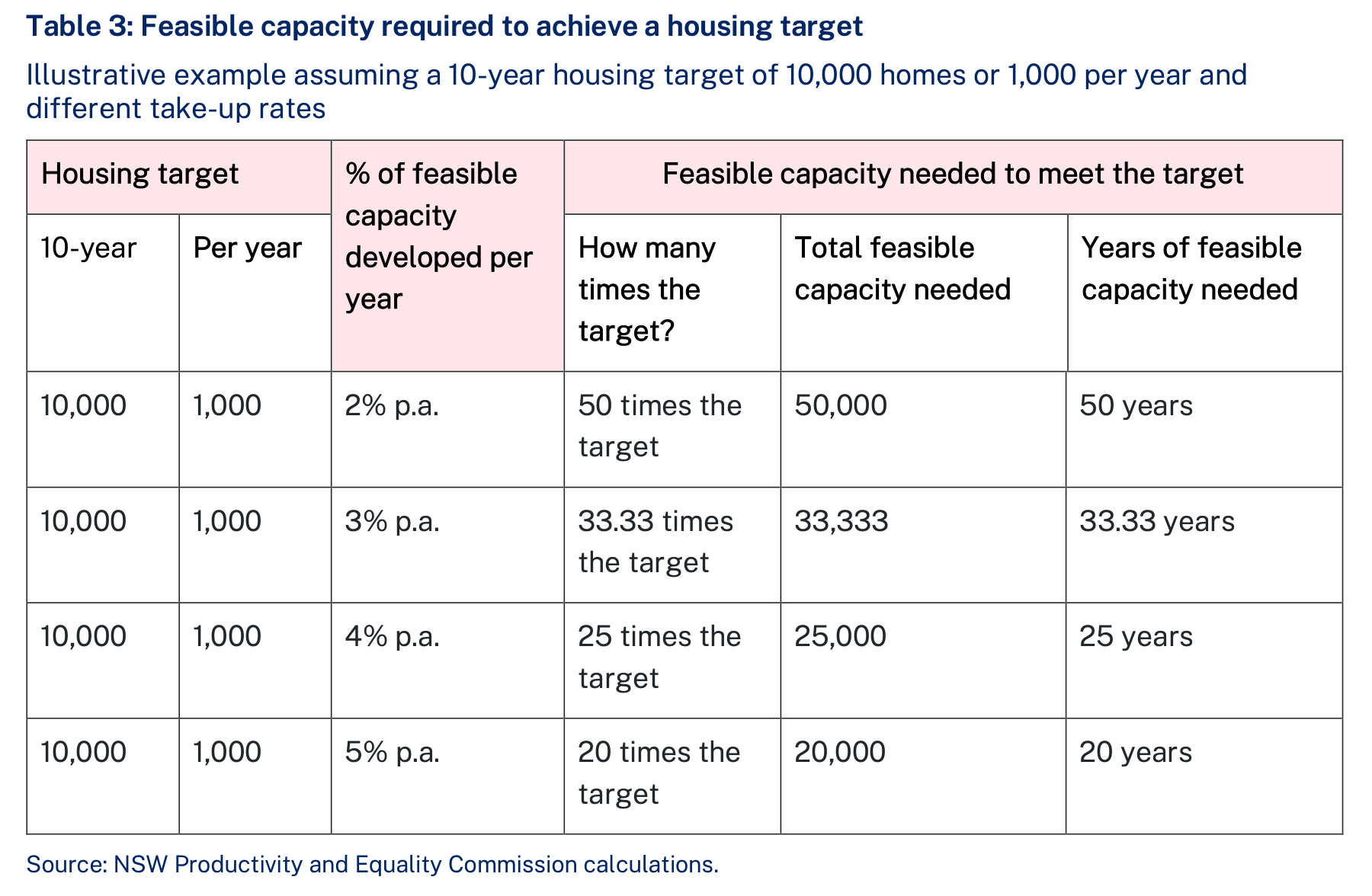
A recent NSW Productivity Commission report also does this dance of contradictions. First, they argue how important it is for the planning system to create feasible capacity to remove this constraint, ignoring that markets will price in these new development rights such that commercially feasible capacity can never be achieved.
They then proceed to acknowledge that they have no idea how much of that feasible capacity they think they can create will get built in any given period, so they present this table. In it, they throw their hands in the air and admit they have no idea what portion of feasible capacity will get built in any period of time. Could be 2%, could be 5%. Who knows?
There is a complete absence of a theory of why change-of-use feasible housing is built or not. To address the strange story they are telling that feasible capacity is the only binding constraint today, but after upzoning some other invisible constraint will bind, they write this gobbledygook.
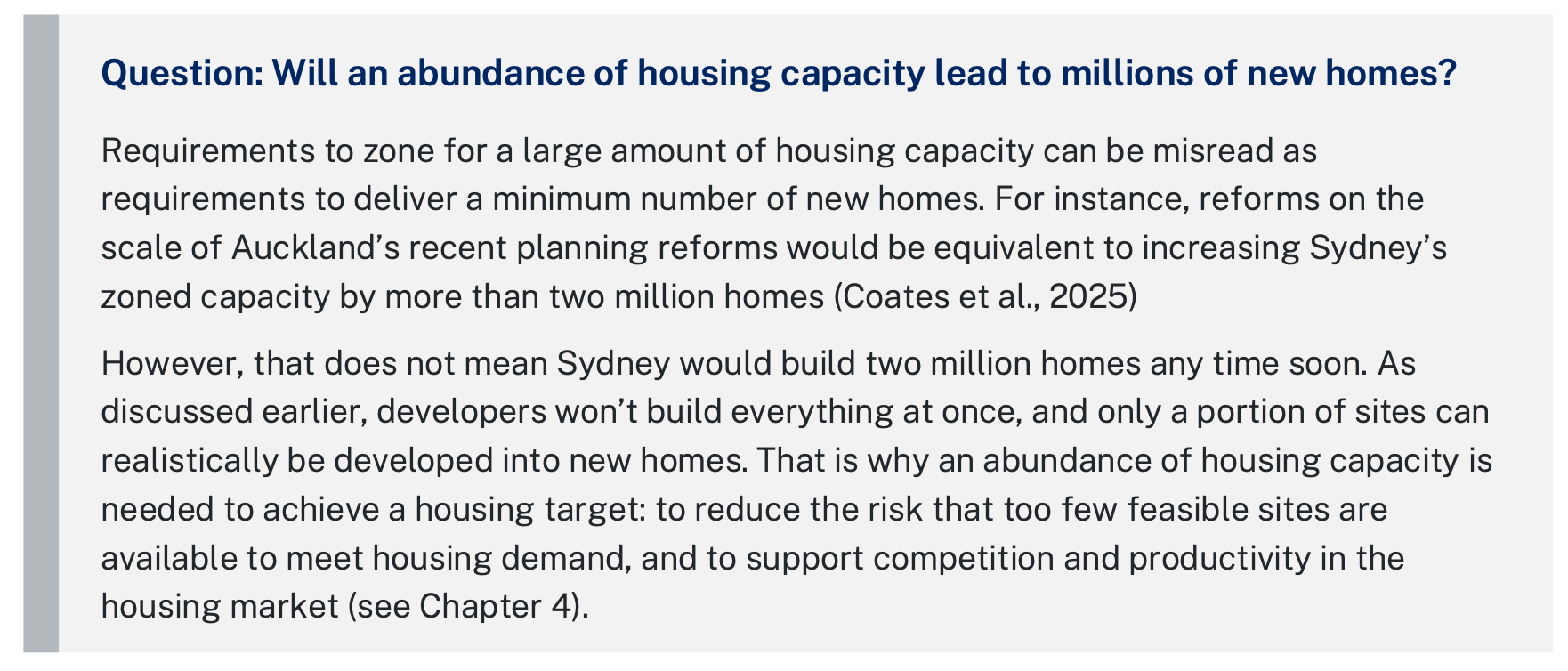
Notice that they are explicitly acknowledging that there are landbanked sites in Auckland today that could produce nearly 2 million homes, and if their proposed zoning changes happen, that will create 300,000 extra landbanked homes.
In short, if you believe there exists change-of-use feasible capacity, you believe in landbanking. If landbanking is not real, there should be no change-of-use feasible capacity—every change of use has already happened.
You can’t have it both ways.
A closer look at landbanking
The reality is that landbankers are holding land for future homes. By my definition, it is a necessary part of a well-functioning housing market that trades off building new homes faster or slower. It is not a behavioural quirk of naughty property owners, whereas the nice property owners build as fast as possible.
It is an emergent outcome across the market such that, on average, waiting earns the same return on investment as developing now. While developers love to argue that waiting is costly (which it is after construction is committed, but not before) this is not generally the case.
We see this with the staging decisions of larger housing projects.
I had put the paywall here, but decided it was more important that these ideas were widely read. If you get value from the rest of this article, please consider becoming a paid subscriber.
If it generated a higher return to go faster, developers would not stage large projects. If they faced cash flow constraints, they would sell future stages to others to develop in parallel rather than in sequence. Indeed, if landbanking were not real and waiting was costly, it should actually be easier to attract investors to fund the cash needed to develop large projects more quickly because that would produce a higher return than developing more slowly in stages.
But why wait?
Remember the supply curve. It is the benefit forgone by sellers. The forgone benefit of developing homes today is the benefit of waiting and maybe developing something different in the future instead.
Since change-of-use feasible sites are assets that retain their value into the future, there is a timing choice.
I find a useful way to think of housing development is as an asset portfolio allocation decision. An undeveloped change-of-use feasible site is an asset that offers future returns. Owners are waiting for a future time to convert it into cash by combining that asset with cash to pay for development. This is just like owners of BHP or CommBank shares—they are earning the gain from waiting for a future time to sell and transform those assets into a different form of asset, be it cash, bonds, or other shares.
This insight alone should make us wary of the idea that waiting is extremely costly for landowners. Because land is tradeable, the most patient and optimistic buyers end up owning change-of-use feasible sites. If two people were bidding for a development site, and one was in a hurry to build as quickly as possible, and another was patient and thought there would be even better opportunities in the future, the second bidder would win the auction and own the land.

The trade-off that generates the emergent market equilibrium rate of new housing production is the benefit from waiting versus the benefit from developing. These competing benefits regulate the pace of development so that the market delivers today’s homes today, but saves tomorrow’s homes for tomorrow.
Waiting provides these returns:
The increase in the value of the site, which comes from some combination of
Rising home prices
Falling like-for-like construction costs
Possible changes to the density and quality choices of future projects
Net rental income from current site use
Developing now provides these returns:
The increase in the value of housing from rising home prices only
Higher net rental income from new housing use
In a rate of new housing production equilibrium, the return to waiting and developing will be the same in risk-adjusted terms. If they weren’t the same, there would be money to be made from speeding up or slowing down new housing production.1
There are two important refinements to this overall economic principle that are necessary to enhance our understanding of landbanking, and hence the rate of housing production.
There is an equilibrium rate of production (how fast homes are produced)
That rate comes out of an ordering of potential projects (in which order homes are produced)
There has been a fair bit of confusion about these two concepts. In fact, that there are two distinct concepts is somewhat of a new discovery of mine. It puzzled me for years that most change-of-use feasible sites were not developed, and very few economists seemed at all concerned by this observation.
My first academic attempt at explaining the economic logic is in this paper.

Like most academic papers, I now realise what I got wrong there. But it was a start.
In that paper, I was also confused about these two distinct concepts: the rate of new housing production and the ordering of sites. Because the same economic force that increases the rate of production pushes some sites back in the ordering.2
Let’s dig in.
The rate of production
The rate of new housing production emerges across all locations and types of dwellings. Often, our conversations about the rate of housing production are actually about the locations of these homes. Best be clear that the rate emerges across many sites, locations, and housing types (i.e. new housing filters across locations, too).
What economic forces regulate this rate? In other words, why does a market of landbankers produce new homes faster or slower?
The best way I know how to begin to explain the emergent market phenomenon of a rate of housing production equilibrium is by analogy. And I have two to choose from.
Equilibrium speed in a highway traffic jam
The first analogy is to imagine a two-lane highway in a traffic jam.
Drivers have the choice to trade lanes when they think the other lane will be faster. Because of this, any time one lane speeds up, drivers switch from the slower lane to the faster lane, and in the process, they make the slow lane speed up when they depart and slow down the fast lane when they arrive.
The only equilibrium outcome is for both lanes to have the same average speed.
The lanes in this analogy are the waiting-to-develop lane and the develop-now lane. The equilibrium rate of housing production is the amount of lane changes from wait to develop that ensures the rate of return to each is the same in risk-adjusted terms (i.e. the average speed is the same for both lanes).
Notice here that every driver is competing to go faster (make higher returns). The outcome is a competitive one, not a monopolistic one. Many more drivers have the opportunity to change from the waiting lane to the developing now lane, but choose not to and are hence landbanking, as necessary in a housing market equilibrium.
Equilibrium rate of food consumption
The second analogy is about food. Imagine you have a house full of hungry teenagers. Their appetites are high relative to others, but still finite. You keep the fridge and pantry well stocked at all times.
Do teenagers eat every food item the moment it enters the kitchen?
Even if they are competing for the best food from the choices available, they eat at a finite rate to match their appetites. When their collective appetites fall, the rate of food consumption falls, and vice versa.
This analogy is useful because it also captures the idea that there is an ordering to the food that gets eaten out of the available food—the rate of calories eaten and the order of food chosen by the teenagers in the “kitchen food market” are different.
The rate of housing production equilibrium is such that you can’t arbitrage by developing homes faster or slower. If you slowed development, others would accelerate their development because that provides them a higher rate of return on their non-housing development investment compared to waiting.
It is a competitive outcome.3
The rate of return on investment rises when prices are rising, or construction costs on a like-for-like basis for the same project are falling. This is like the other lane speeding up and offering a higher return to switching.
The diagram below helps illustrate and visualise this idea.
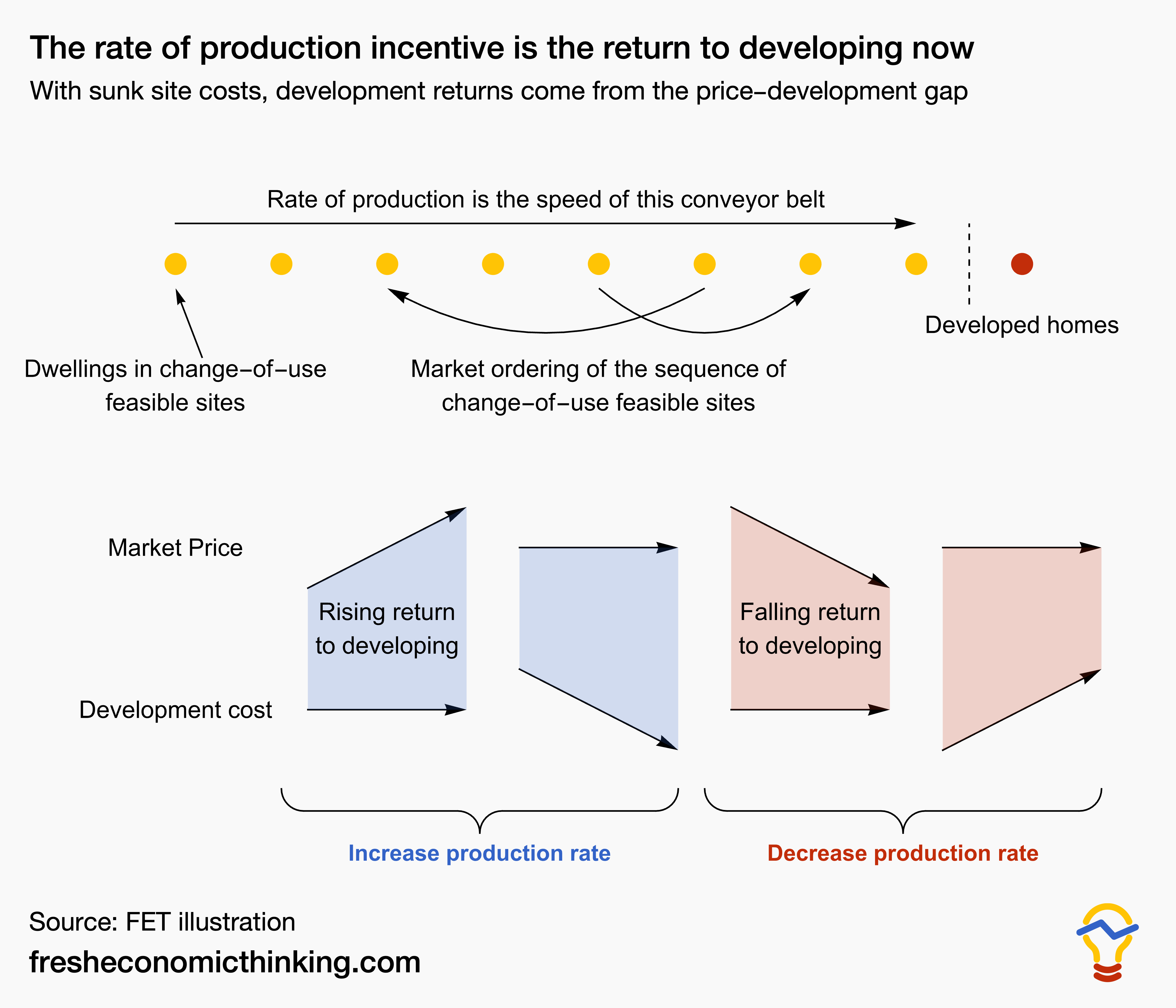
The top shows the sequence (pipeline) of yellow change-of-use feasible sites, moving into developed housing at a particular rate. The ordering in this sequence is discussed below.
The bottom of the diagram shows the scenarios that make changing into the develop-now lane more or less economically attractive. When the gap between market price and development cost is rising, it means a rising payoff to development. When the gap is falling, it means a lower payoff.4
If we look at this price-development cost gap in recent years, we can see a pretty clear relationship with the rate of new housing commencements. In the next chart, I take this gap, remove the long-run trend, and plot it alongside new housing commencements (both scaled).
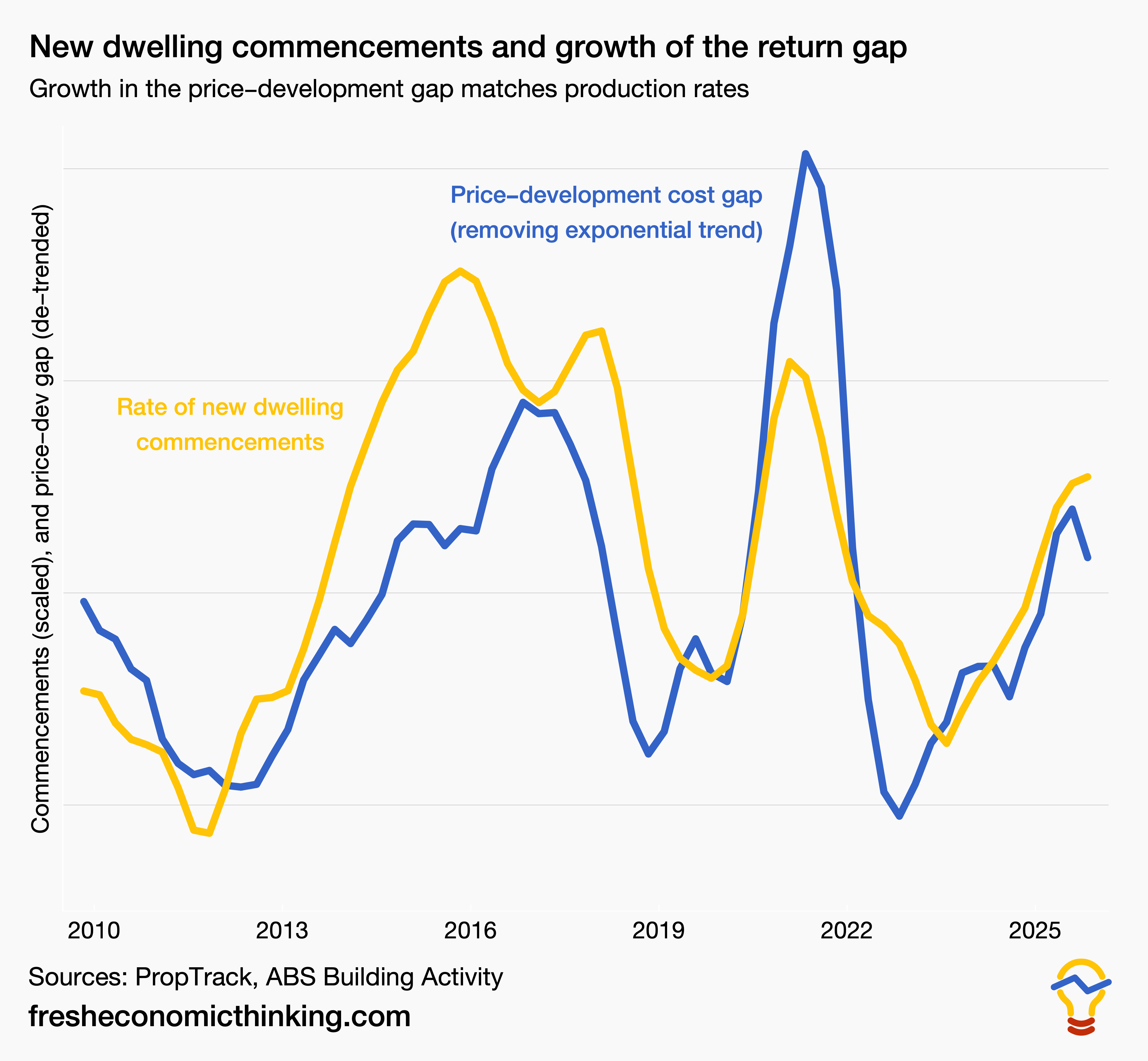
As a proximate cause of whether homes are built or not, the trade-off between waiting and developing is the answer.
But if you zoom out to look for deeper causes, things get weird because the cycle in new housing development is part of broader macroeconomic trends.
Here is a chart from Twitter analyst Mark the Graph (Bryan Palmer) showing that after a variety of tests, the best predictor of building approvals for new houses was the approvals last quarter plus the change in the unemployment rate.
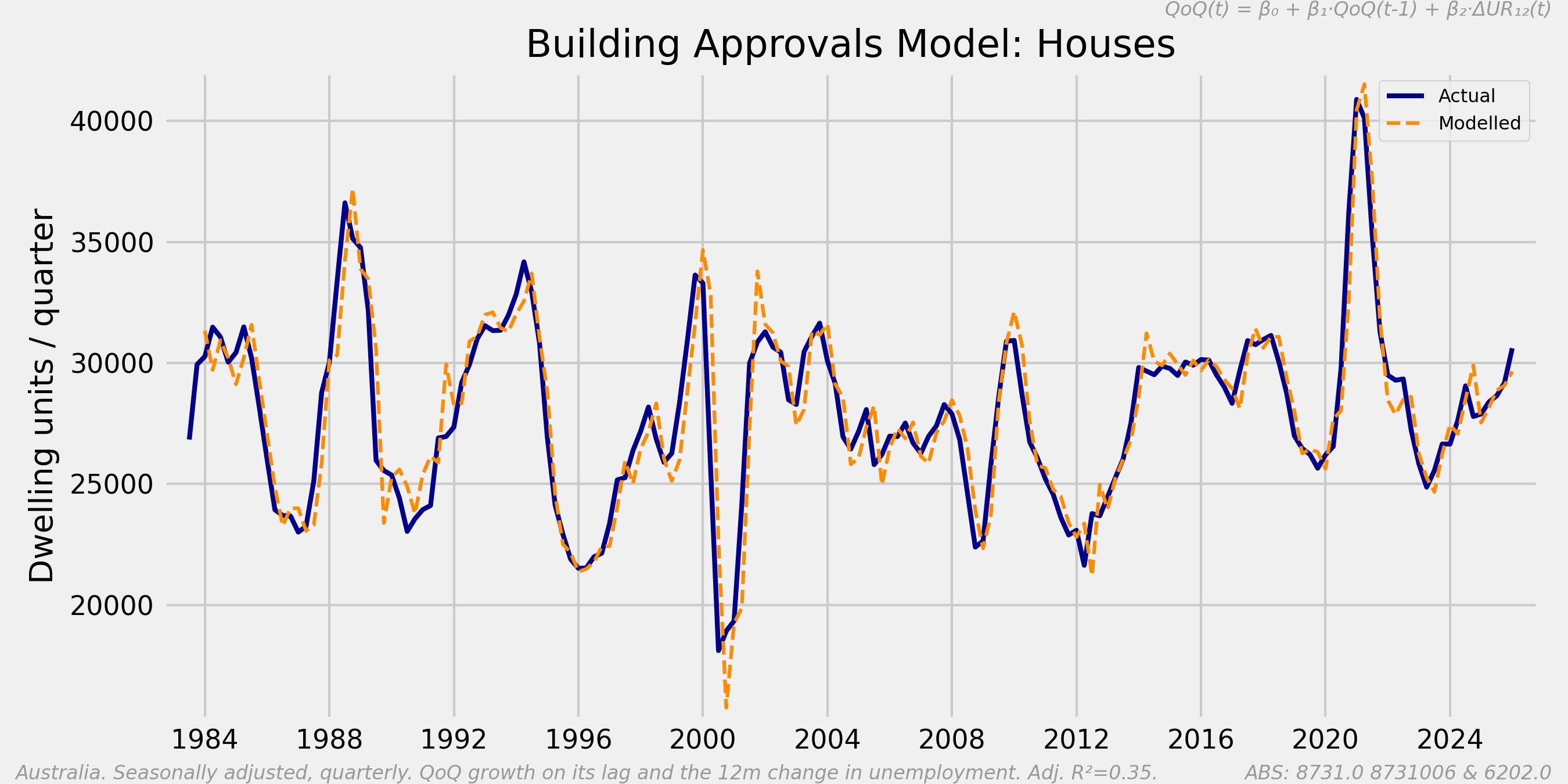
Why would rising unemployment predict stronger approvals? As he says:
That’s because approvals lead the economic cycle and are driven by interest rates, and the RBA cuts rates precisely when unemployment is climbing. So “unemployment rose over the past year” really stands in for “the RBA has been easing,” which lifts approvals. The unemployment rate is just a cleaner, less noisy way to capture that monetary cycle than the cash rate itself.
Rising unemployment usually goes hand-in-hand with lower construction costs, and falling interest rates make current prices more justifiable to buyers. This fits well with the micro-level story of a rising price-development cost gap leading to faster home building.
The ordering (sequencing) of housing sites
Back in 1931, Harold Hotelling noted that mineral and coal resources, like locations for new homes, get sorted into a sequence by market forces.
They will be removed and used in order of accessibility, the most cheaply available first. If interest rates or degrees of impatience vary among the mine-owners, this fact will also affect the order of extraction.
So too do a variety of factors affect the ordering of sites into the housing production rate. Another market equilibrium emerges where you can’t arbitrage and make excess returns by changing the order of sites in the housing production line.
The most interesting part is that where density and quality are flexible, rising prices lead to some sites being pushed back in the sequence. The rate of return from waiting at that site increases relative to other sites, even though the equilibrium rate of production also increases. This reorders the emergent market sequence of sites to be developed (illustrated in the above image).
To use our teenager’s appetite analogy, when they are really hungry, and the “rate of eating” equilibrium is high, it will also be the case that this involves a reordering of what they choose to eat out of the kitchen—the pasta moves to the front of the line and gets eaten first, but the fruit goes to the back of the line and gets eaten later.
As we saw in the Part 1 FET article in this series on change-of-use feasibility versus commercial feasibility, a pushback in the order (or sequence) is associated with a rising land value of that site. The market assessment of this sequence is expressed in the pricing of change-of-use feasible sites.
As we saw in the Part 2 FET article in this series, rising prices usually mean there is a payoff to changing to a higher-density housing project.
The equilibrium arises because you shouldn’t be able to arbitrage by changing the sequence of sites into housing development—if you could, then the sequence would already be changed.5
Rising prices, therefore, have the effect of
increasing the equilibrium rate of production, and
re-sorting the order of sites and, in doing so, changing the delay premium pricing of some sites more than others.
Both the rate of production and the value of delay are emergent market outcomes.
In our teenage food consumption analogy, this sorting is equivalent to them choosing which foods from the kitchen to eat first. There is an order to this. Even if you are really hungry and eating quickly (high demand, fast equilibrium rate of production), those kids might still leave the unripe fruits for later.
There is an interesting tension between the production rate and the ordering of sites.
Some projects, when prices are rising, will move backwards in the order. These are ones where, for example, there is extra gain to be made from increasing the density of a project in response to higher prices. The market pushes forward other projects, and these projects move back in the order.
The fact that there are really two elements to the absorption rate—the rate of development and the sequence—helps explain some of the confusing results of real options theory. There are unresolved contradictions in that theory, since a higher future payoff provides an incentive to delay new housing at a site, but rising prices (which are necessary for higher future payoffs) bring forward development.
A resolution comes from identifying the two separate effects of rising prices, where one effect is on the rate of production, and one effect is on the ordering of the sequence of sites into production.
So what?
Landbanking is a normal and necessary part of the property market.
No one truly wants the homes we might desire in the next few decades to be built today. Market traders learn how quickly to develop housing via trial and error as they try to develop homes faster or slower in response to return incentives.
It seems to me that an obvious step one before assessing the effects of regulation on housing markets is to understand how the market works. That means understanding why landbanking is real.
I think confusion often arises because when planning rules change and new housing types are developed where they were not previously allowed, this is interpreted as extra housing, rather than a different location, and hence ordering of the overall rate of production.
In terms of our food analogy, it is as if you buy a new food for your teenagers and put it in the kitchen, and suddenly they start eating some of it. But you don’t notice that they eat less of other things, and the net result is simply a change in the ordering to bring forward the new food and push back the other foods within the same overall rate of food consumption.
If landbanking is a normal part of the market, just like keeping food in the kitchen until your appetite grows, then we have already refined what are sensible questions about housing policy.
Instead of assuming all change-of-use feasible housing is ready to be immediately built, due to regulations, we see that the normal situation will be to have an enormous pool of change-of-use feasible housing landbanked for the future.
We can ask more refined questions like “How could we know if the market isn’t optimally delaying housing for the future?”
Using our food analogy to argue that planning rules reduce the amount of housing might involve arguing that planning rules stock the kitchen with brussels sprouts and other undesirable foods. If only the planning system would stock the kitchen with doughnuts and mangoes, then the rate of food consumption by these teenagers would be higher.
But at least we are now getting the economics right.
Regardless, the economics of the rate of housing production is often ignored, but when you dig in, it explains why landbanking is a necessary part of any property market, and changes completely the underlying assumptions about how markets work that motivate many people to deny its existence.
As always, please like, share, comment, and subscribe. Thanks for your support. You can find Fresh Economic Thinking on YouTube, Spotify, and Apple Podcasts.
If you insist that supply and demand must apply, that is true. Supply in this dimension is the benefit from waiting, and demand is the benefit from developing now. And the quantity of trades is the rate of production. Supply and demand MUST apply. We just need to get the trading dimensions and benefits correct, which is why I generally limit my use of these often tautological terms.
For the true econ nerds out there, the order of sites into production is similar to the capital reswitching question—which sites go first is analogous to choosing which type of capital (machines, equipment) to use.
The whole idea of “land is a monopoly” is something I have also grappled with for two decades. My view has now evolved. I see all markets as a type of monopolistic competition, and the idea of price-taking, perfectly competitive markets has always been wrong, and probably more confusing than useful. Here are three previous FET articles where I grapple with this idea: one, two, three.
Strictly speaking, both market prices and like-for-like development costs are also emergent market outcomes of demand and growth in macroeconomic allocation to construction.
Like all market equilibria, it is not perfect—it emerges via trial-and-error trading.
I like you have called it out. I see a lot of skirting around the edges through denial of, or anger toward land banking. A question - How does adding in more competition (i.e. new developers) have a material impact on house prices? Or despite any number of developers (or competitors), we will still be stuck in a two-lane race? Is there a number of competitors that change this (i.e. increase the number of supermarkets to feed the hungry teenagers, or will all supermarkets continue to offer their minimum returns and we are just skirting around the edges?).
Separately, you may have seen the new Sydney region plan talks to sequencing and staging. Based on your article here - I am a little pessimistic for how effective a sequence or staging will be. How would you overlay the market dynamics of staging and being able to fund infrastructure in a timely manner.
ALL of this assumes high population growth.
Population growth can come from only a few sources:
1. The birth rate - which mainly impacts the need for more bedrooms, but essentially young people entering the housing market when they leave school, or can afford to move out, or have to relocate to take a job.
2. Immigration - net immigration really, though some students and temporary workers are not in the normal housing market but may live in dorms or crowded conditions.
3. Migration within a country - rural to urban, or from poor to richer areas.
There is short term and long term land banking. A developer who has staff and contractors should be creating an assembly line in effect with multiple projects on the go, much as a craftsman will have enough inventory of supplies to not run out. BUT longer term land banking is when the returns from holding land to be developed are higher than other returns.
What turbo-charges land banking are limits on land nearby. These can be legal barriers like green belts, they can be water - particularly on islands or peninsulas, or it may be land that is not possible to build on easily - mountains, parks or environmentally protected areas. Another one might be servicing - roads and highways, but also planned water and sewer mains and areas that will not get these soon have to be held longer.
What is missing in this analysis? Simple. RISK AND RETURN. The more construction a developer has at any given time, the more capital or debt it consumes, but also the risk. Real estate is cyclical, and of course, more supply does also depress prices. But similar to the highway lanes analogy, capital can be deployed in construction to generate cash and profits, or it can be invested in property where it may require cash flow if rents don't cover the opportunity costs.