

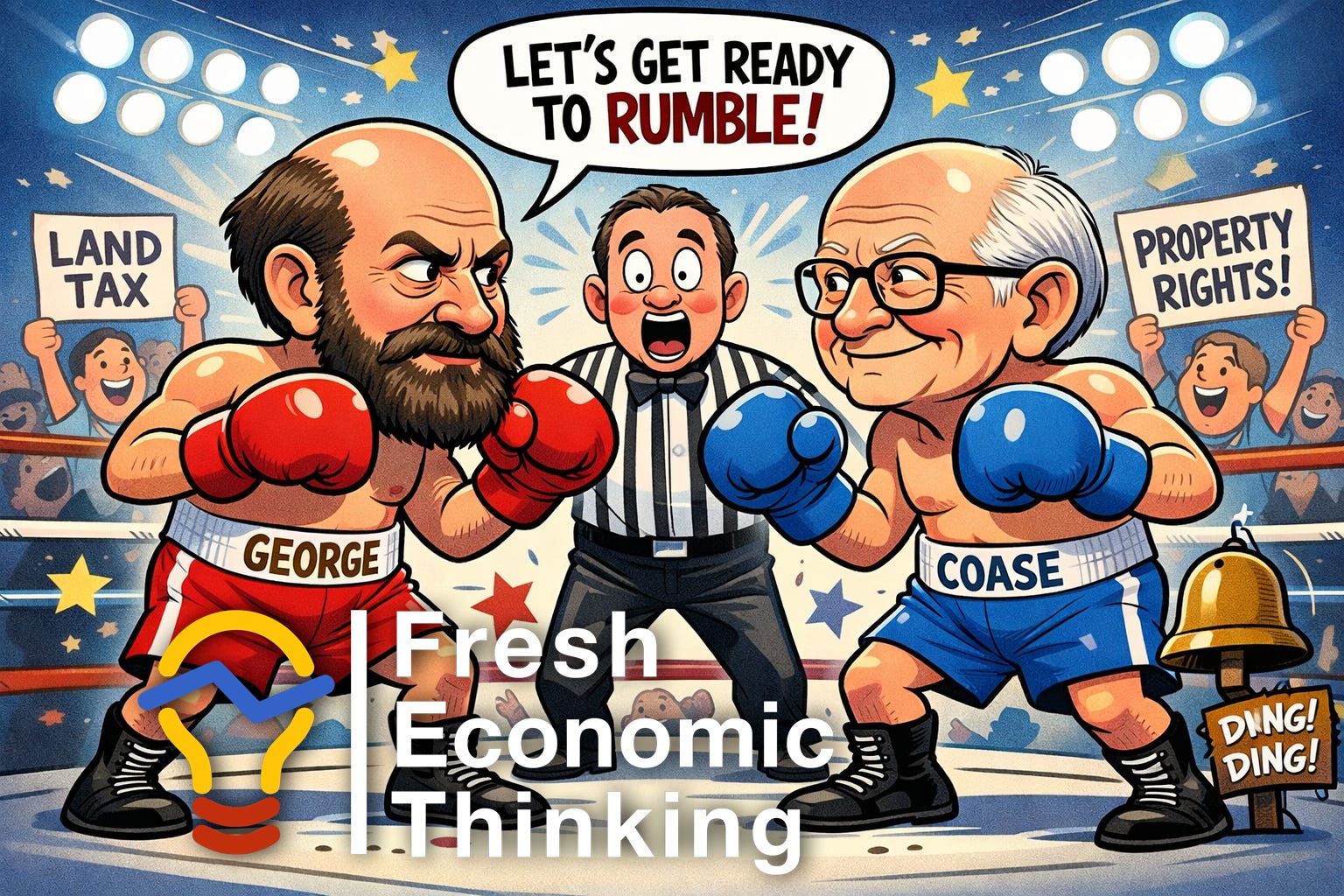
Henry George was a man of the 1800s.
Born in 1839, he was preoccupied with the coexistence of progress and poverty during a volatile period of economic change, marked by severe boom-and-bust cycles. His solution was to tax land—put a price on excluding others from the gifts of nature. He also opined on the economic benefits of free trade and the trouble with tariffs and protectionism. His lifetime of insights led to a global social and political Georgism movement. He died in 1897 as the 1890s depression was ending.
Ronald Coase was a man of the 1900s.
Born in 1910, he was preoccupied with transaction costs, which create a trade-off between using market and non-market means of coordination, and provide the incentive for the existence of firms. For our exposition, it was, however, his related ideas on the nature of property rights as low-cost tools for economic coordination that provide incentives for efficient allocations and investments. His lifetime of insights was quietly appreciated by policymakers and economists, informing the development of new institutions like radio spectrum property rights, but led to no public global movements. He died in 2013 as the financial crisis was ending.
The economic concerns of the 2020s are similar to those from the times these great thinkers lived, including access to property and housing, the role of tariffs and trade on social and economic change, and the boom-and-bust cycle.
Today, I want to imagine what a meeting between these two great thinkers would be like. How would their intellectual and moral arguments unfold?
What would Coase make of the idea of taxing land as a remedy for either boom and bust cycles or accumulating inequality and access to housing?
What would George make of the arguments for efficiency of property rights in general, which apply as much to land as any form of property we create (intellectual property, mineral rights, airspace rights, radio spectrum, etc.)?
They seem like obvious allies, but the record doesn’t show it.
The more I grapple with the economics of property, and particularly the housing concerns that come and go with the cycle, the more I feel it is high time for the Georgist movement to modernise and incorporate the economic lessons of the past century, especially the insights of Ronald Coase.1
Two important ideas about property rights
Coase’s idea
Ronald Coase reckons property rights are useful.
One of his insights was that the exclusionary nature of property rights, combined with low-cost trading opportunities, incentivises an allocation of those rights to individuals and firms that value them the most. Property rights generate economic efficiency if they can be traded at low cost.
