


Australia’s Productivity Commission (PC) is an in-house economic research group for the federal government. They run inquiries into matters referred to them by politicians, and respond with sensible policy comments and recommendations.
At the end of May, Treasurer Jim Chalmers asked them to look into Housing Supply Regulation. Those wishing to make a submission to the inquiry were given three weeks to do so, and the PC is expected to report their findings a month after that.
Two months to solve housing. Again.
I’ve attached below a submission I made with Tim Helm focussing on the economics of why new homes are built. You can read all the submissions to the PC here.

Interested in learning more? Sign up to be a paid subscriber to support FET and get access to all articles and audiobooks.
Fresh Economic Thinking runs in-person and online workshops to help your organisation dig into the economic issues you face and learn powerful insights.
One more time with feeling
When you step back a little, giving the PC two months to solve housing with yet another inquiry is comical political theatrics. Unequal access to housing has been an issue for centuries, and it reflects broader changes to economic inequality during both booms and busts.
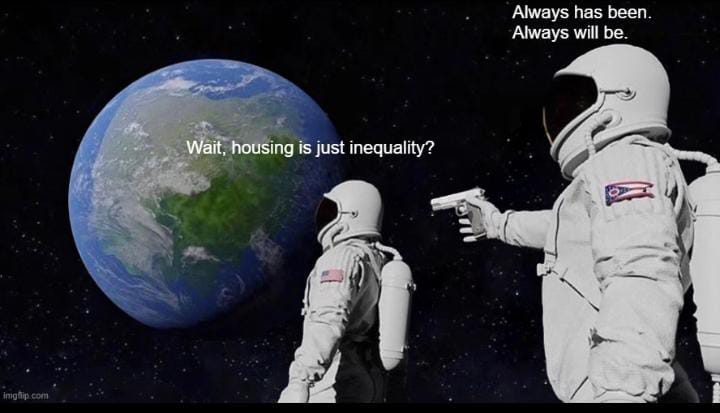
The “coexistence of progress and poverty” emerges through uneven distribution of housing and land ownership during periods of rapid economic change, including inflationary periods.
Back in 1911, for example, there was the NSW Inquiry into Fair Rents that led to the 1915 Fair Rents Act. For the century since, we have constantly inquired, reviewed, and investigated housing. If you spend some time in the archives of Trove, you will notice this pattern. Below is a headline from 1963 about the housing shortage, for example.

The 1970s inflationary period most closely mirrors the 2020s in terms of the political debates about housing. For example, home asset prices in Brisbane doubled in the first four years of that decade, while inflation was about 40% cumulatively. In the past four years, Brisbane prices have increased 50%, and cumulative inflation has been 20%.
But we never seem able to zoom out and see these patterns.
Governments have responded to the cycle of public concerns with many reports and reviews in recent decades that focus on the micro level, seeking out a regulatory tweak here or there to leverage for large housing market effects, which never arrive. I noted as such a few years back in my submission to that year’s rental inquiry.

The table below is an AI summary of these many housing reports and inquiries (so please send me any corrections). As you can imagine, many more industry and think-tank reports on the same topics have been written as well.
Australia’s 2026 housing market in context
The strange part about all these inquiries is how they confuse the cyclical for the structural.
For example, the 2017 to 2021 period was one of the cheapest times to buy Australian homes in over two decades in terms of the cost of renting money to buy a home or the cost of renting a home directly. Falling interest rates, rising incomes, and flat nominal prices had resulted in a substantial market adjustment that was hard to see when looking at the asset price of homes alone.
During COVID, we dropped interest rates further and stimulated the economy, as did many nations, leading to a global housing price boom. In recent years, we tried to unwind this with higher interest rates, intentionally making buying a home more expensive to reduce home buying and, in the process, reduce home prices and new housing construction (to dampen inflation).
Yes, it is a difficult time to buy a home in 2026. No, it won’t always be like this, and it did not get like this because of long-term structural issues.
If we look at the more stable part of the housing market, the rental market, we actually see nearly four decades of flat rent-to-income ratios for renter households, who are generally occupying bigger and better homes.

The terms of reference for the new PC inquiry start with the claim that “Australia has a housing shortage.”
Does it really?
I’ve looked into housing shortage claims and analysis before and found they are generally very poor and often confuse the housing outcomes that emerge from both inequality and consumer choice to be a problem of having the wrong number of homes.

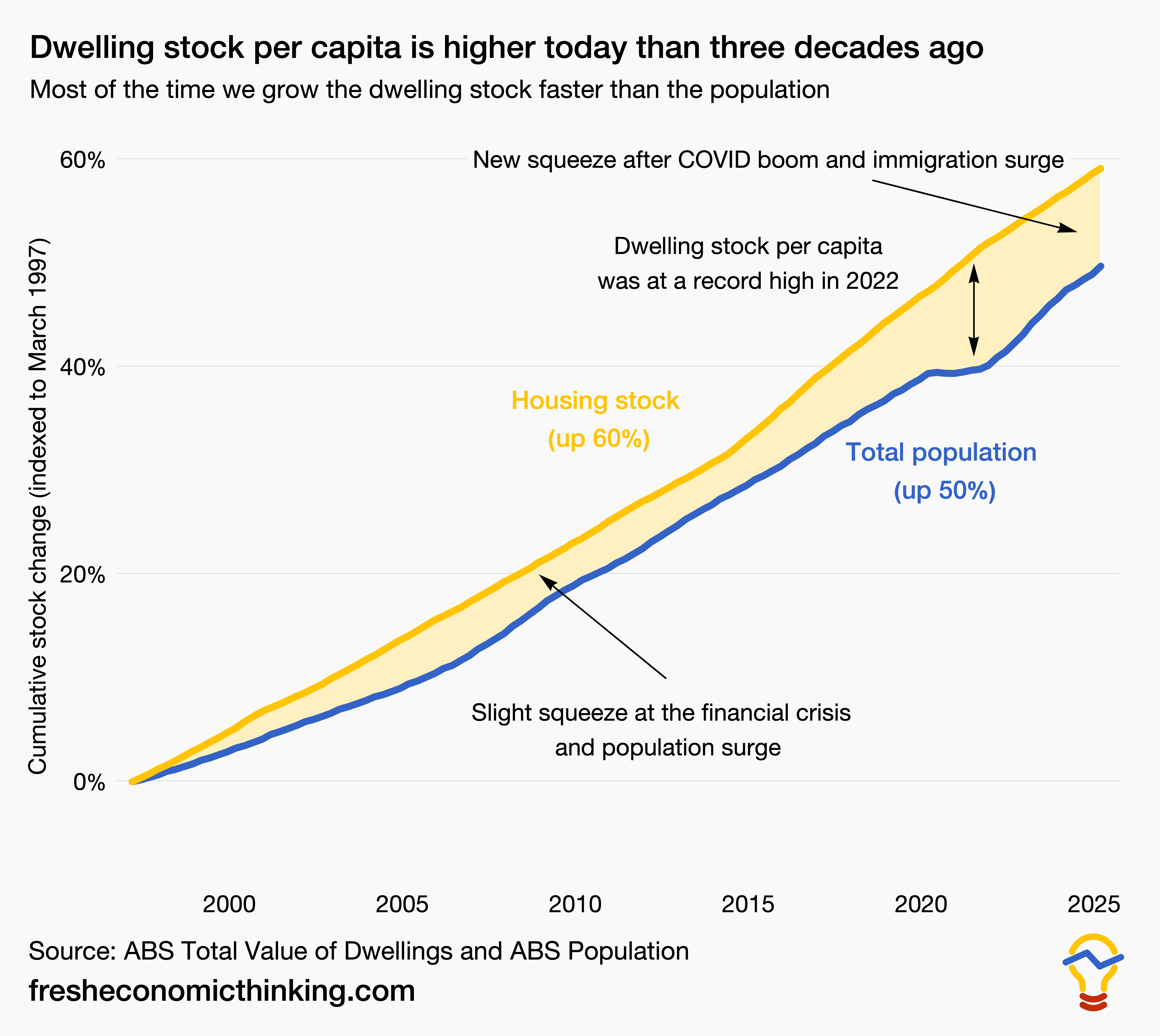
In fact, the stock of homes relative to the Australian population was at a record high just a few years ago, and this housing stock was bigger and better in quality than at any point in history. Since the borders reopened, this has come back a tiny fraction, which I suspect is a temporary adjustment—I predict that in 5 or 6 years we will hit a new record for dwellings per capita.
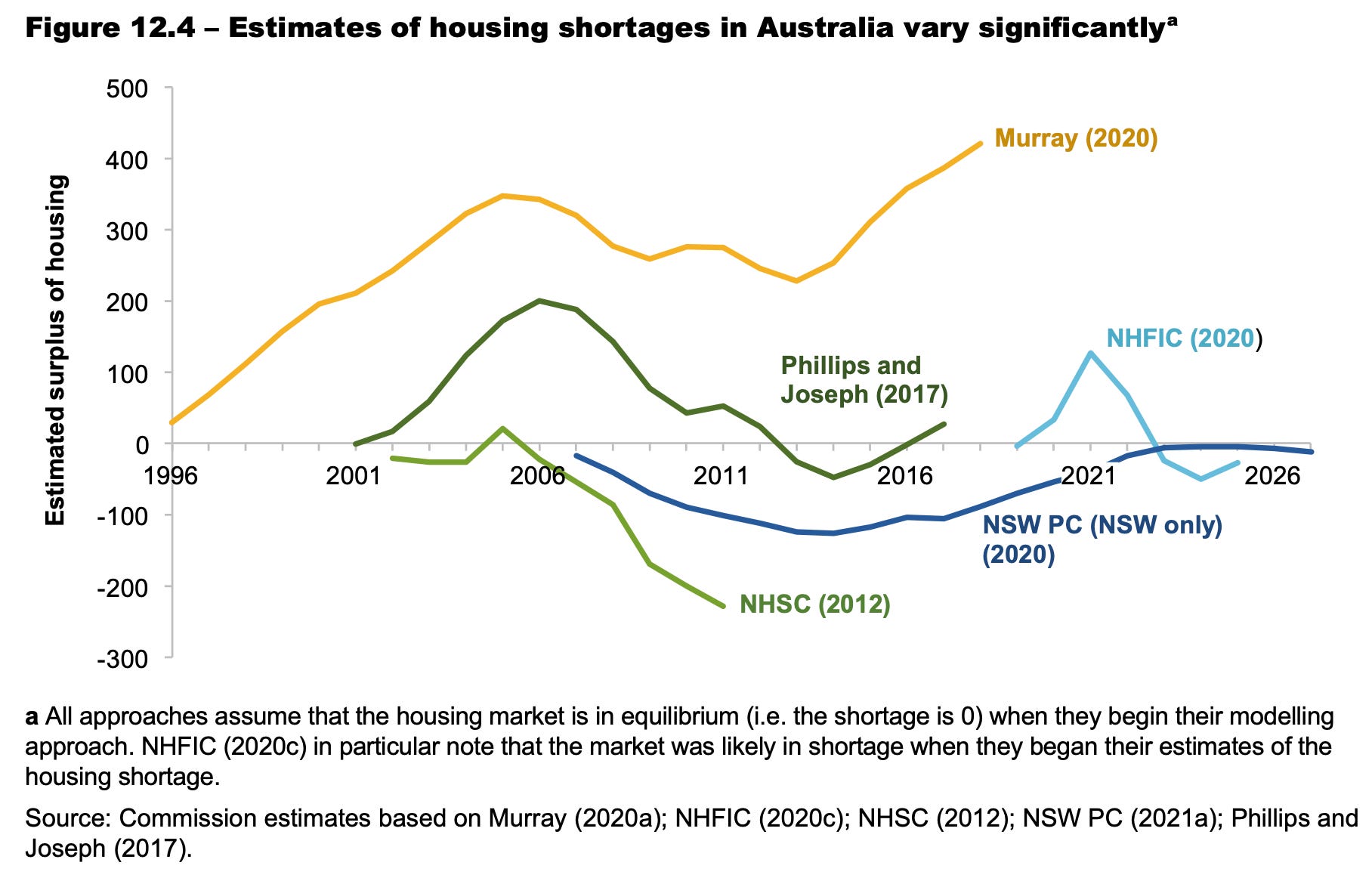
The strange part about the PC’s shortage claim is that even their own 2022 report showed a high level of disagreement about the idea of a housing shortage, as seen in this chart (p472).
The same housing shortage concerns are happening in the United States, which has totally different housing regulations and planning rules. Many people think there is a shortage, but no one knows the right number—maybe somewhere between 1 million and 8 million in a country with 150 million dwellings (or between 0.7% and 5% of the total stock).
So what?
Yes, buying a home is not easy in 2026 compared to the 2017 to 2021 period. Yes, there has been a rental squeeze as borders have reopened and incomes have risen unevenly.
But these are cyclical phenomena.
Despite all these inquiries, I don’t think there is general agreement on what is wrong with the housing market. I explain in my book, The Great Housing Hijack, why that is, but to briefly summarise, there is an inherent market symmetry that can’t be ignored. Landlords, developers, investors, and homeowners want prices to rise. New buyers and renters want prices to fall (at least until the day they buy). Renters want lower rents and landlords want higher rents. At every point in the market cycle, one or the other group is upset, and we must respond politically to that with an inquiry.

We first need to acknowledge as a nation how property markets work. Then we can decide how and when we might want to intervene, and for whose benefit. Despite all the inquiries for the past century, I don’t think we are there yet.
If you are interested in issues of construction productivity and its measurement, I can recommend this two-part FET series from last year:


As always, please like, share, comment, and subscribe. Thanks for your support. You can find Fresh Economic Thinking on YouTube, Spotify, and Apple Podcasts.
Cameron and Tim
I am pleased that you have provided a submission to the Productivity Commission explaining the importance of applying real options thinking to housing and land markets. It is amazing that so few economists in places like the Productivity Commission and other government departments and institutions have not applied the real options thinking of Avinish Dixit and Robert Pindyck (Investment Under Uncertainty, 1994) and Mason Gaffney (Extractive Resources and Taxation, 1967) to analysis of housing, land, and natural resource exploration and extraction issues.
PC people picked it up from my writings in PC reports 35 and 10-15 years ago in relation to exploration and extraction, but clearly that work has been missed/forgotten by the current crew and/or they did not realise that real options thinking should be applied to land use as well as exploration and extraction.
My only concern with your PC submission is that some parts of it could have been explained more clearly. I understand the real options thinking of Gaffney and Dixit and Pindyck, but still had trouble with your wording in some places. It either could have been expressed more clearly or my understanding is lacking or both. I will read it again.
It will be interesting to read what the PC has to say in its report.
Ken Willett
For utility planners having a good forecast model of housing formation is essential. Two key parameters are population growth and housing occupancy. Behind these are economic parameters such as GDP per capita, mining investment growth (a WA thing), factors that could influence housing affordability. The big issue is there can be a lot of forecasting error in all this. So planners tend to overestimate the requirements because underestimating can be more costly- at least politically. This could be a source of why we perpetually have housing shortages.