

Post-budget, there has been a lot of fuss in Australia’s media about taxes.
Today, I want to experiment with simply sharing a few concepts that help me think coherently about taxation as an economist, and where the confusion and blind spots are in the taxation discourse.
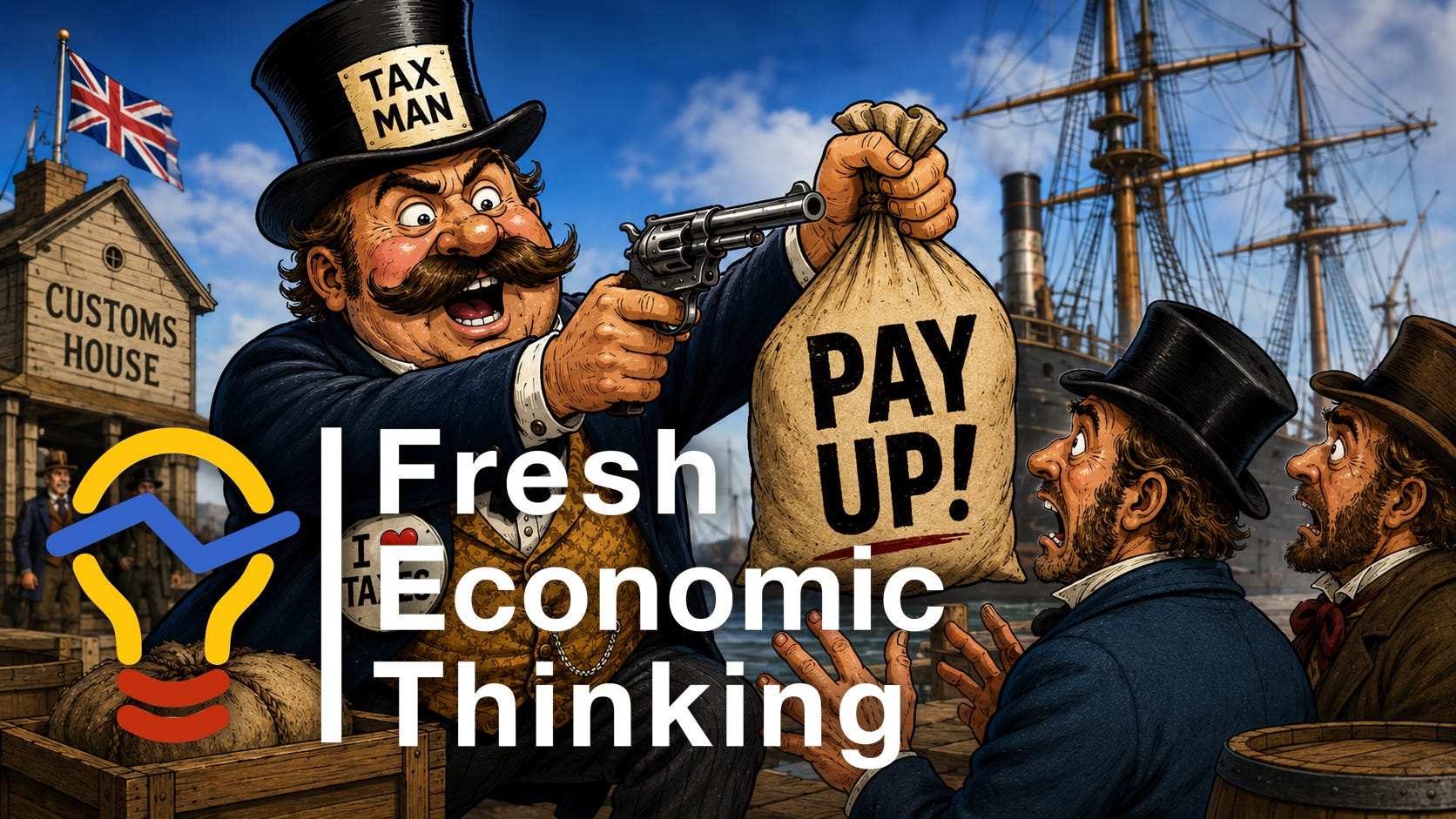
The main question I ask to help make sense of it all is, “Where do I send the guy with the gun?”
Tax bases versus people taxed
The important thing is that a tax base is not a person, except in the case of a head or poll tax (which is what we call a per-person tax on simply being alive for a period).
People have claims to things after tax rules have been applied to tax bases.
The value you own is the value after the rules of society are applied, not before. Your home is your home after the rules of society about property rights apply, not before. Your income is your income after the rules of society about taxation apply.
We all know this. People are incentivised by their after-tax incomes, not their “before tax” personal income, or what I will call the tax base for personal income taxes.
One of the biggest conceptual confusions is that taxes take your income. No. Your income is determined after the rules have been applied and all the price and output adjustments have taken place.
Tax bases are not people—they are places we can send a guy with a gun.
This has a few implications.
First, it means that taxing big, observable things that cannot be hidden are the best tax bases. That’s why historically taxes were raised from trade—on imports and exports that went on ships, and on land and its trade.
The tax base could be the tonnage of the ship, and you could charge a fixed tax per commodity, or it could be the value of the cargo, and you charge a percentage on that (called a tariff). On land, the tax base could be the area of land, on which a per-area tax would be applied, or the value, which would be a percentage land value tax, or the value of all fixed improvements, a property tax, or it can also include mobile property like motor vehicles that are big and easy to track.
As the economy became more sophisticated, we began taxing tax bases that were previously unobservable and therefore hard to enforce, such as personal income. In a world with minimal record-keeping and few large-scale businesses, this is hard to do. So we created systems like withholding, whereby businesses that pay employees don’t even give the employees the before-tax income (the tax base), but give them the after-tax income and apply the tax to the tax base on behalf of the tax office.
We can easily send the guy with a gun to big organisations that own major facilities.
This also means that the complexity of the tax base is a killer. The Petroleum Resources Rent Tax (PRRT) applies to a tax base that is a special convoluted accounting construct that leaves many opportunities to account differently to minimise it.
Taxing unrealised capital gains (change in value of assets owned), for example, fails not because of any economic theory about the nature of this gain versus an income payment, but because there is no tax base there to be taxed. Without the sale, there is no value to tax. It fails because we don’t know where to send the guy with the gun.
In fact, taxing income from capital (dividends and capital gains from owning businesses, interest payments on loans, etc) is tricky in general because ownership and lending can occur across national borders for not much more cost within them. Why not relocate ownership to a lower-taxing jurisdiction? Ireland, for example, has one of the lower corporate taxes in Europe, so attracts a lot of ownership into the jurisdiction, most famously aircraft leasing services.
People who gain from minimising the tax base will always do it.
So make sure tax bases are an easy place to send a guy with a gun and won’t simply disappear or be relocated because of a tax.
Want to find out more about how property rights create predictable incentives and price patterns?
Come to my two-day intensive Land and Housing Economics Workshop in Brisbane tomorrow.
Will the workshop help you invest? Probably. Will it help you understand policy? Definitely. Will it help you cut through the media nonsense about housing? Certainly.
There are a few spots left. Last chance to book here.


Tax incidence
When we say tax incidence, what we mean is the net effect on the after-tax wealth and incomes of different people after new tax rules have been applied.
Adam Smith notably described how difficult it is to really work out which people are worse off or better off after a new tax is applied because behaviour and prices adjust (see the Wealth of Nations, page 690 of the version here).
Economists call the net effect on the income and wealth of different people due to a tax the tax incidence.
For example, stamp duty is a tax that applies to the tax base of the transaction price of a home. It is the responsibility of the buyer in the transaction to pay this tax to the state, not the seller. But the tax incidence is not on the buyer, but the seller. We know that the price of homes adjusts upwards by a dollar for every dollar a stamp duty is reduced, and vice versa. Imposing a stamp duty reduces the seller’s wealth and income on net, not the buyer’s, even though the buyer sends the money to the revenue office.
If you conflated the administrative payment of a tax with the “people it taxes”, you would be wrong. It can often be the case that this is true, but usually the tax incidence is less than 100% of the person or company with the responsibility of tax payments on a tax base.
Any given tax setting is just a system of rules operating, and there are no “before-rules” outcomes, except insofar as there are measurable things called tax bases.
For example, the stamp duty described above decreases the value of property trades, and in doing so, decreases its own tax base. The property value is already different because of the tax, so that value is not the “before tax” outcome.
Tax equivalences
Often, analysis of taxation will revert to what I call ad hoc equivalences. This means that people impose a model of how they think a fair world works and compare a tax to that imagined world.
A popular example of this is to assume that taxes on the tax base of personal income are actually meant to be taxes on personal consumption. Here’s an example of such an equivalence claim.
This is important - we have a background principle for an income tax of equal sacrifice where we are thinking about people in similar situations sacrificing similar amounts of consumption in order to fund government services. In all of this discussion this is a central principle.
Why should income taxes try to reflect an underlying principle involving consumption? The Goods and Services Tax (GST) is already a tax on the tax base of the value of consumer goods.
Where does this central principle come from?
Consider supporting FET to read on to find out what’s wrong with this claim.
