

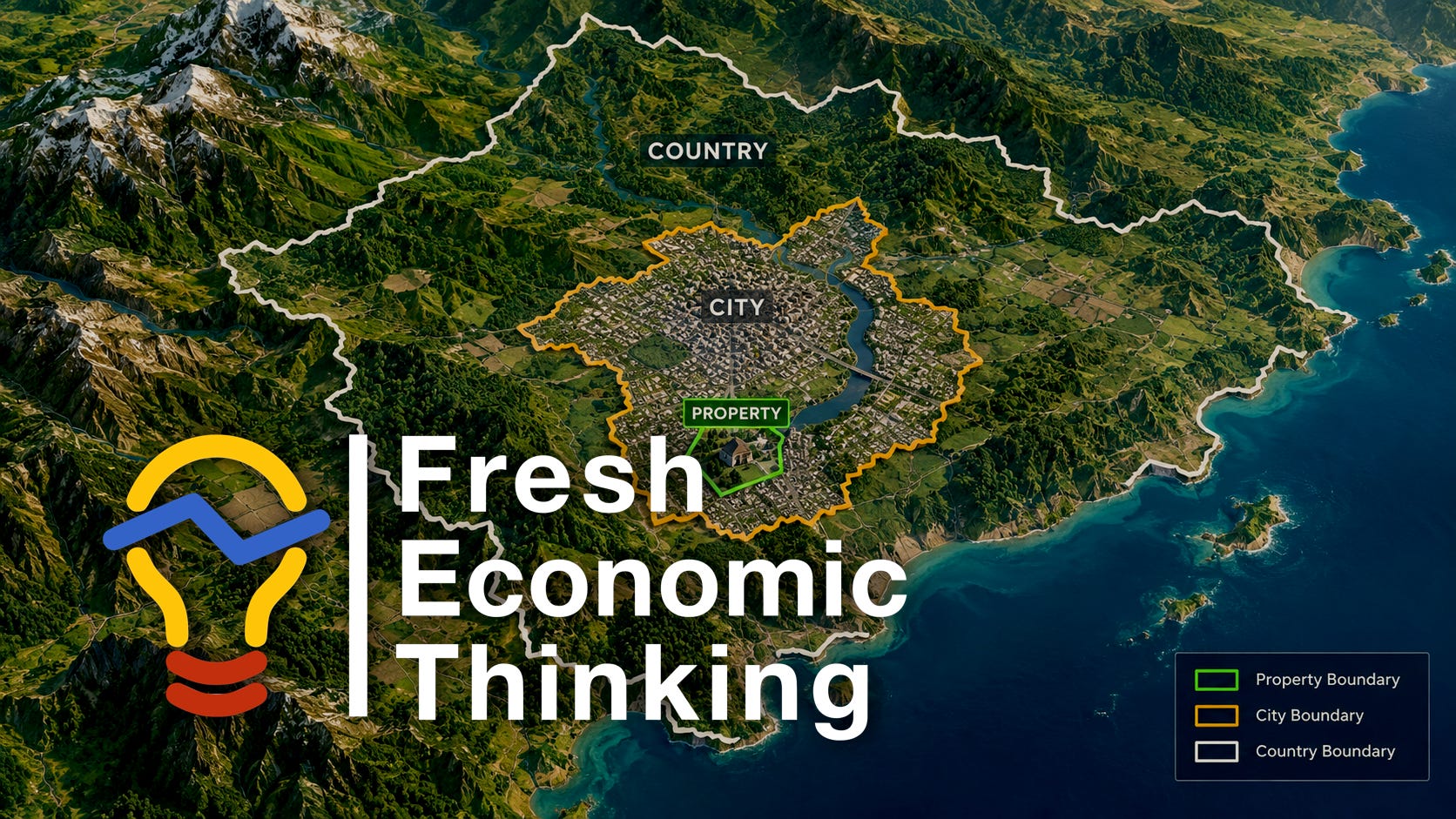
Have you heard that “Everyone has the right to live where they want”?
Now think of the person who said it. Which side of politics were they on?
Sometimes it is hard to tell.
Bernie Sanders thinks open borders are a right-wing conspiracy against the local working class. He responded to a question about open borders back in 2015 like this:
“No, that’s a Koch brothers proposal.” The idea, he argued, is a right-wing scheme meant to flood the US with cheap labor and depress wages for native-born workers. “I think from a moral responsibility, we’ve got to work with the rest of the industrialized world to address the problems of international poverty,” he conceded, “but you don’t do that by making people in this country even poorer.”
Meanwhile, the libertarian right, the Kochs and economists like Bryan Caplan, champions open national borders while treating private property lines as sacred requirements of freedom.
Much of the left does the reverse. It is comfortable with national borders when Sanders defends them (though this is changing), but lukewarm about the borders around private property.
Each side picks the borders it likes and calls them real and natural.
I have found the lack of political consistency about borders hard to fathom.
On the one hand, property is freedom. Freedom to exclude. But then those who apply that logic think national borders are oppression. Exclusion is oppression.
But I think this is misguided. All borders do the same economic job: they stop convergence and create internal investment incentives. And if that’s true at the property border, then it is true at the national border as well.
Stand-up comedian Arynne Wexler captured the political contradictions about borders and the rules that govern them in this bit about Homeowners Associations (HOAs).
I love the drama of the HOA.
My favourite part of the HOA is actually just how everyone’s politics are totally inverted.
Have you guys noticed this?
Conservatives become liberals and liberals become conservatives.
Like your Kamala girly neighbour. You know that passive-aggressive b*tch. The people that are like “defund ICE, no one is illegal.” They know exactly where their property line is. They love security and fences, right?
Conservatives. We’re the lawless creatures. We’re kind of crazy. Like I will shoot off my fireworks and fly my Cracker Barrel flag if I so choose.
And then we get in trouble for not asking permission and just painting a very tasteful 20-ft mural of a shirtless Kid Rock.
And then your neighbour comes out to you with like the rules of the HOA. Someone cares about founding documents all of a sudden.
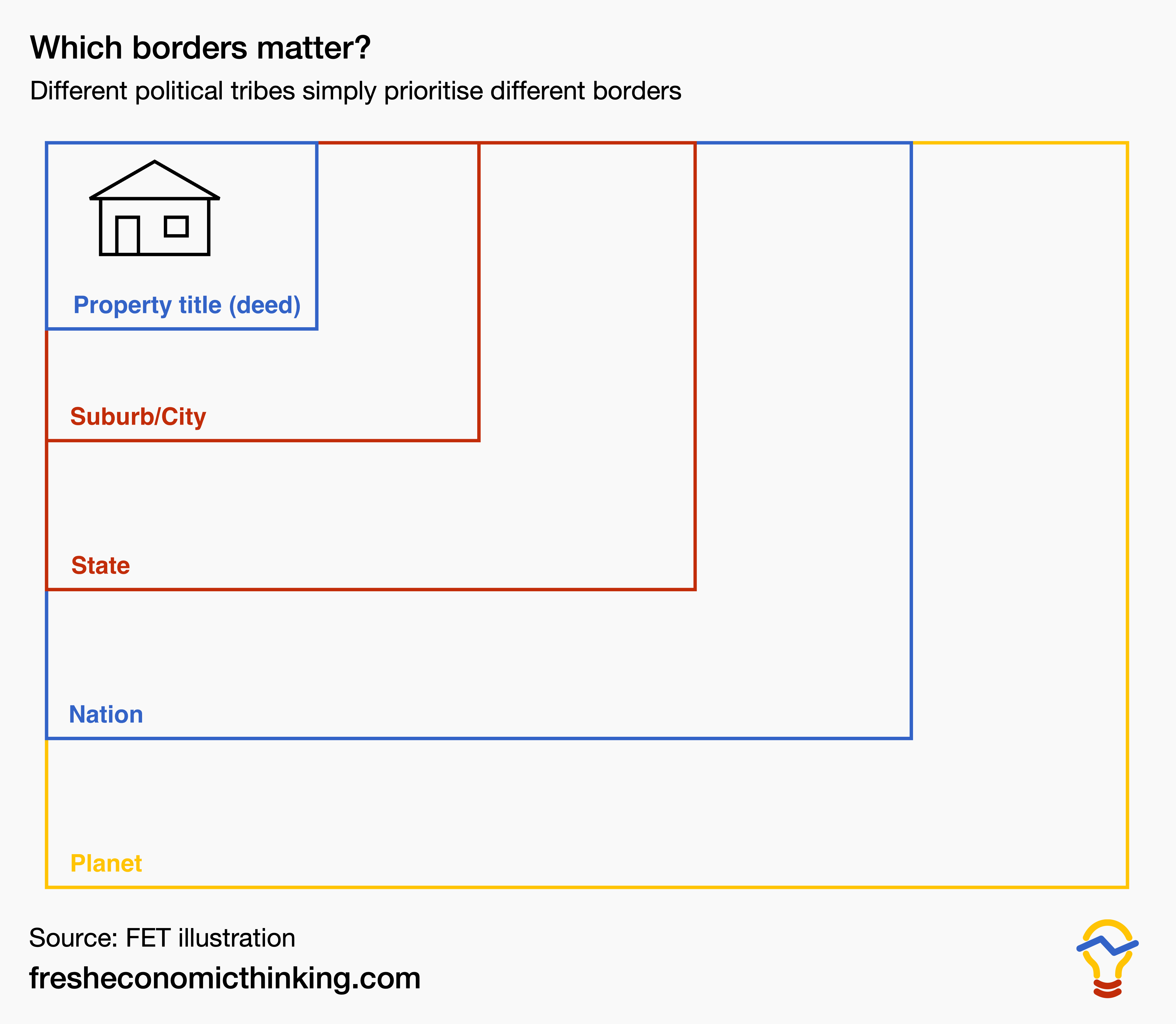
Borders come in layers
A border defines a group that makes rules about behaviour within it, hopefully in their collective interest.
Inside a property I own, I set the rules about who gets access and how things work. Whoever is on the title, or deed, gets to be a little dictator.
But that dictatorship sits inside larger borders, and it has to obey those higher-level rules. Those rules include, for example, how I can contract some of my rights to a tenant, who then becomes a temporary dictator.
If the property is in a strata building, the building’s rules override mine. The building must follow city rules, and the city must follow national rules.
At each level, people inside the border get to participate in rule-making, voting in strata meetings, or voting for city, state and national elections.
One important rule at each level concerns who gets to be inside the border. National borders are regulated by visa systems, treaties and agreements. Property borders are regulated by the invitations of residents.
The diagram below helps illustrate the nested nature of borders.
The blue borders are the ones we often argue about: private property and nations. The red ones are often forgotten borders with less salience because they generally don’t involve restricting movements. And yellow? It is there to show that if we suddenly became aware of advanced alien lifeforms, we would immediately recognise a planetary border and set rules about who gets to cross it.
Natural borders are in the eye of the beholder
Which borders are real and proper is a fundamental question in debates about property rights and immigration rules.
The tweet below reflects a common way that property borders are argued to be the real and natural ones that must be primarily respected. If animal groups behave in a way that creates exclusive territories, then exclusive property-rights borders seem natural, no?


But why interpret exclusive territories as private property borders and not national borders?
These are packs of wolves with territories, not individual ones, like property title holders. Each individual wolf appears free to roam within the pack borders.
You could just as easily interpret wolf pack behaviour as evidence that national borders are natural but private property borders within nations are not.
Nobody does, because the choice of which borders count is mostly ad hoc. It sits unexamined underneath the policy debate.
A better question is what borders actually do.
Convergence is why borders matter
Start with a block of land.
Private property borders allow the property owner to build on their land knowing that others can’t freely access what they have built. If you take the border away so that there is free access to the land and the buildings, two things happen. First, the property owner loses the incentive to invest because they can’t keep others away and charge for access. Second, if investments are made, the benefit of them is lost because of a tragedy of the commons scenario—the building will quickly become a homeless squat or be scavenged for materials.
The sum of these effects is convergence. The quality of something inside a border converges to the quality available outside the border.
The same logic applies up the border layers.
That’s why, for example, gated communities have gates. These groups don’t want the shared spaces within their border converging in quality to those outside the gate.
Imagine a community pool in a gated community, but where the border that regulates access to it is removed. People will arrive to use the pool, and as the crowds build, the experience will degrade for each person trying to enjoy it. Maybe that point is where 100 people are at the pool most days, but the 101st person chooses not to go to the pool because the value has converged to their next best alternative (perhaps the time and cost of a trip to a less crowded beach instead).
Economists have a term for this—spatial equilibrium. If people can move to improve their quality of life, they will, until the gains are competed away. The benefit available at each place converges.
Spatial equilibrium happens within nations as people migrate freely from city to city, town to town. The only borders that limit this are private property borders, the price of which prevents further domestic migration (and why the price of property reflects all benefits from that border available to the property owner who gets to reside in it).
Where the private property border is no longer a barrier to domestic migration, such as for the homeless, convergence is more obvious: the homeless congregate in areas wherever the most accessible amenities (for them) are.
The same logic applies to nations
Immigration across national borders is a hot debate globally in 2026. At one extreme are open-borders advocates like Bryan Caplan, who simply take as given that private property borders are the natural and just ones, and other borders are ad hoc and arbitrarily infringe on the little dictatorships of private property owners.
At the other extreme, we have the majority of the residents of the Western world pushing back politically against massive changes to who resides within their national borders.
The convergence lens explains why the national layer matters too.
A nation’s shared institutions, public goods, infrastructure, and culture are like the community pool in the gated community. People invest in them via taxation and the various local, state and national institutions, and via their lifestyles and behaviour. They do that because they get to decide who can access them and are part of the group with exclusive access.
This is just like any club. Gym members contribute financially to the cost of maintaining the facilities, but if access it not restricted to contributing members with a border, then where is the incentive to maintain that investment?
So what?
Too often we ignore the nested layer of borders that regulate our lives.
“Everyone has the right to live where they want” is usually said by someone defending one border layer while ignoring another.
But every border layer does fundamentally the same thing, economically—it prevents convergence by creating the incentive to invest and preventing the degradation in quality of internal amenities through overuse and exploitation.
Exactly how open any border should be is a separate debate, one that the people inside each border get to have. The right to have that debate does not belong to one layer only.
Those within each border have the freedom to choose who crosses that border. If property borders fundamentally provide that freedom, then so do national borders.
Put Fresh Economic Thinking to Work
Why a paid subscription matters
A paid subscriber to FET wants intellectual challenge. They don’t want someone to write what they already think. They want insights that are hard to get elsewhere and a public debate that is intellectually honest, not tribal.
Subscribing is a vote for independence — you're saying I want Cameron Murray to have the financial freedom to investigate things that other economists won’t.
If that sounds like you, and you get value from the research and analysis published here, I’d appreciate your financial support.
A fresh economic consultancy
Most economic consultancies begin with the conclusion a client wants. They sell institutional credibility and a report. I sell economic thinking.
If your organisation has a difficult economic question, a policy argument that needs testing, or a problem where you want to get beyond the usual consultant consensus, I’d like to hear from you.
FET also provides custom economics training, presentations and workshops for organisations that want their people to understand the economics behind the issues they work on.
If there are economic concepts, debates, or blind spots your team needs a genuine handle on, then please reach out.
Ground Rules: Land and Housing Economics for Professionals
Put that professional development budget to work with an upcoming FET Land and Housing Economics workshop in Sydney or Melbourne.
This two-day workshop is crafted for smart researchers, policy analysts, economists and planners who want to truly understand how land and housing markets work.
This course may be eligible for CPD points from your professional Institute. Please check directly with them.
Sydney tickets here.
Melbourne tickets here

More details here.

As always, please like, share, comment, and subscribe. Thanks for your support. You can find Fresh Economic Thinking on YouTube, Spotify, and Apple Podcasts.