

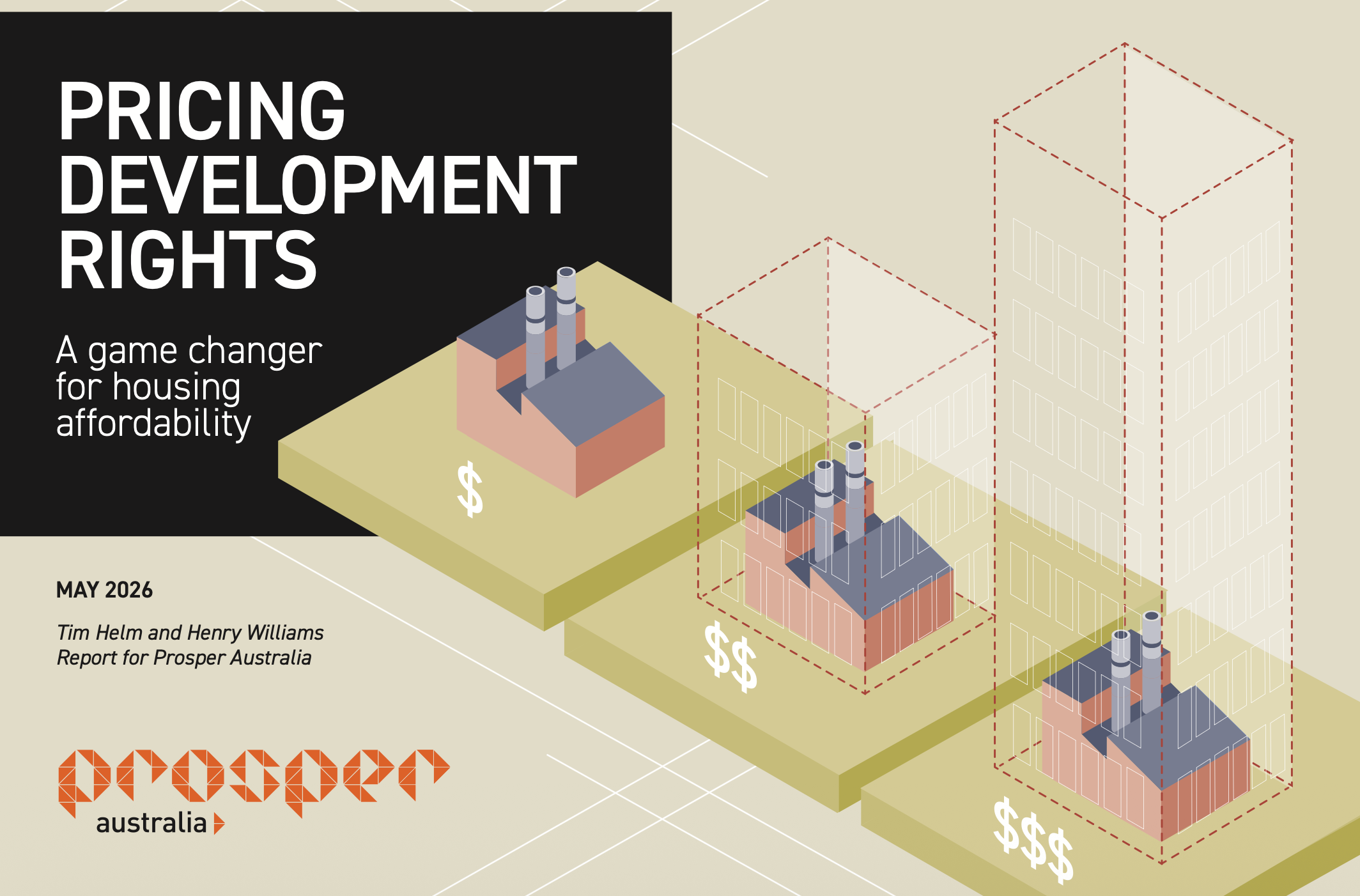
Prosper Australia released a report last week explaining how and why to price development rights.
Download a copy here.
The basic idea is that property rights are created and defined by the state. So when high-value rights are added to the bundle of an existing owner, they should be priced rather than given for free.
As the Prosper report explains:
The legal right to use land in specified ways is how society regulates the use of a common resource for the public good. There are no natural rights to landownership, and no rights inherent in land title – rather, the bundle of rights that makes up landownership is always and everywhere a creation of the state, and relies on active enforcement by the state.
…
The right to develop or intensify land use is not inherently part of this private bundle. In modern planning systems, development rights are retained by the state to be granted through planning approvals.
The limited nature of property rights makes total sense when we talk about other rights. The property rights to undersea mining, radio spectrum, or intellectual property are all clearly invented by the state and limited, and changes to those rights are a negotiation with the community that creates and enforces them.
The same is true with property rights to spaces (i.e. land).
Before I share an extract of the report with more explanation, I want to push back on a common argument that I expect in response.
That argument is that if you upzone small areas, the value of the extra property right is high, but if you upzone a whole city, the extra value is low, and hence there won’t be much value to capture from pricing the extra rights.
As one recent article noted:
Development rights are only valuable because our planning systems have choked the supply of new housing in the most desirable parts of our cities, driving up prices for everyone.
This is wrong.
Development rights are valuable because asset markets price them such that there is no arbitrage. That’s it. Just like all property rights.
For example, say you owned the intellectual property rights to Medicine A, where the rights bundle expires in ten years. Your competitors own the intellectual property rights to Medicine B, but their rights bundle lasts in perpetuity.
Even if the same profits could be generated from each medicine each year, one property would be worth more than the other. As it must. The market price today of any property rights, intellectual or real, accounts for all future flows of profits and their risk.
If we changed the property rights for Medicine A through “intellectual property upzoning” so that they now last in perpetuity rather than ten years, would that mean there is more competition for longer-lasting intellectual property, and less competition for shorter-lasting intellectual property, so that the price of Medicine B and its intellectual property value will fall?
No.
The pricing of property in any form, whether real or intellectual, always reflects the most profitable way to exploit that bundle of rights.
We, as a society that creates, defines and enforces property, could sell the longer-term intellectual property rights for Medicine A. Only a ten-year period of rights has been granted. So from year eleven onwards, the state holds in reserve the intellectual property rights.
These longer-term rights could be auctioned off, whether in the form of a bundle that lasts another ten years or a bundle that lasts from the end of the current ten years in perpetuity.
To give them away to the owner of Medicine A’s ten-year intellectual property rights bundle would be a massive unpriced transfer. Yet that is how we do zoning in the cities.
Zoning rules describe what new property rights the state is willing to grant in different locations, and the planning system, through the approval process, hands over those valuable new property rights for free to those who apply.
Scroll down for a report extract and PDF.
Want to find out more about how property rights create predictable incentives and price patterns? Come to my two-day intensive Land and Housing Economics Workshop in Brisbane.
Will the workshop help you invest? Probably. Will it help you understand policy? Definitely. Will it help you cut through the media nonsense about housing? Certainly.
Book here.


Pricing development rights
There is a deep unfairness at the heart of Australian housing policy. State governments, by way of their planning systems, are routinely giving away public assets worth billions of dollars each year.
Legal permission to develop land in new and more profitable ways is a valuable property right. Development rights are created by and belong to the public. When transferred to private landowners, they should be priced at their private value. Right now, most states are handing them over for free.
The result is a system of enormous windfall gains. By way of rezoning and planning permission, development rights worth an estimated $11 billion are granted to private beneficiaries each year. This silent, legalised giveaway delivers vast sums to some of Australia’s wealthiest landowners, with the public receiving nothing in return. This is plainly unjust.
Development rights are public property, held in reserve for public purposes. To transfer these to private landowners is a healthy and necessary part of economic growth and change. But the value of these rights should accrue to the public, not the private owners who happen to hold title.
Such a giveaway would be plainly unacceptable if rights of the same value were transferred in the form of a separate, horizontally-defined land title. When public land is given away, or sold at ‘mates rates’, the injustice is obvious to all. And when private landowners sell land with a planning permit attached, they expect the price received to reflect the value of the permit. By contrast, the equivalent giveaway of public airspace remains the status quo within Australian planning systems. This is clearly unacceptable, and as the next section shows, the value being given away is enormous
The estimated $8 billion raised each year could pay for the abolition of stamp duty for all first home buyers, benefiting 90,000 buyers each year, while also funding an additional 195,000 social housing dwellings, a 43% increase on the current stock.

As always, please like, share, comment, and subscribe. Thanks for your support. You can find Fresh Economic Thinking on YouTube, Spotify, and Apple Podcasts.
Why would you price development rights rather than pair upzoning with a land tax that hits in both build and no-build conditions? And isn't it still preferable to let private actors collect the development rights for free rather than just arbitrarily keep it illegal?
I dont know what the answer is. Allowing local governments to zone land, based on favours for mates, self interest, or disallow zoning for same reasons, is not working. Allowing State government to make the decision is just importing gross incompetence.