


The above photo is of my house in Brisbane. It was built in the early 1880s.
The original portion of the home is 46 square meters (460 square feet) internally, with a small front and rear verandah. It sat on twenty timber posts dug into the earth and secured by ramming in the dirt around them. It had four doors (two external, two internal) and eight windows. It did not have a single electrical wire, light, or power plug. It had only water piped into external taps and an outside toilet.1
Now?
This same home has six lockable doors and twelve windows with flyscreens, and sits on steel posts on a concrete slab, with earthworks undertaken and retaining walls built to manage stormwater. It has a complete internal kitchen and bathroom, insulation, electric wiring, lights and air-conditioning, a driveway, a garden with edging, a laundry, and a fibre-optic connection. The home has also grown to double its original size due to various renovations over the years.
What’s my point?
A house today is not the same as a house historically. We made our houses better because we are richer now and housing is a great thing to invest in with extra wealth and income.
These radical changes in the very idea of what constitutes a house are a key issue when it comes to the concept of construction productivity, which seems to worry so many.
Don’t get me wrong. I want more productivity in every sector, not less. But I think we are being tricked by the way we interpret some of the data and we miss the fact that the construction sector, even the residential sector, is so vast as to be its own macroeconomy. It hence contains the same economic compositional effects as we see in the macroeconomy more broadly—changes that William Baumol explained six decades ago.
Let me explain.
Troubling construction productivity declines
It’s not impossible to get worse at producing something. History is littered with examples of societies forgetting how to make things. We still debate today how ancient mega structures were built because we collectively forgot. Knowledge only persists if it is used and embedded in our activities.
But as anyone who watches the terrific B1M YouTube channel can attest, we seem to be building more and more seemingly impossible construction projects all the time.
So what is it that concerns us?
Measured construction productivity has remained flat while other sectors have grown, or outright declined, in Australia, the United States, Canada and elsewhere over the past four decades.
It is a worry for many. After all, it sure sounds bad!
So what exactly are we dealing with here?
Construction productivity is simply a metric that comes from dividing two numbers—a measure of construction sector outputs and a measure of construction sector inputs.
Typically output is measured by value, so if a construction contract to build a home is worth $400,000, that is the output measure. It doesn’t care about WHAT is in that $400,000—whether a garden shed or a luxury apartment—just that it is a measure of the market value of the output.
The inputs are what exactly?
Well, they can’t be a value. If they are a value of inputs of labour time and materials, then productivity change is just a measure of the change in margins and declining productivity would indicate an increasingly cost-competitive construction sector.
For example, if decades ago your $400,000 construction contract required $300,000 of inputs, providing a 33% margin on cost, but it now requires $350,000 of inputs, then margins have compressed to 14%. But that doesn’t tell us about productivity.
We need to divide a quantity by a quantity, not a price by a price, to get something more meaningful.
The most common construction productivity metric, called labour productivity, gets us halfway there. It asks “How many on-site work hours did it take to produce $400,000 of construction value?”
It still uses value as an output metric, but a quantity of the important labour input as the input metric.
But please note that some analysis of construction productivity relies on a metric called total-factor (or multi-factor) productivity which merely adds to the measurement issues at play by trying to count the input quantity of labour and every other input such as capital (equipment usage) and materials. The layers of measurement issues make this total-factor productivity metric a very bad way to understand construction.2
Sometimes in housing debates people will measure dwelling production per worker, or total dwelling square meters built per worker, focussing more narrowly on housing and on quantities or output and inputs.
So keep an eye out for what exactly is being talked about when you read about declining construction productivity.
The puzzle for many is that labour productivity in manufacturing and many other sectors keeps increasing—we get more cars per car factory worker, more bottles of soft drink per Coca-Cola worker, and more agricultural produce per farm worker—but in construction, we get the same output value per on-site construction worker.
Why?
I want to focus on two things in this article—1) measurement issues and 2) the economics that helps us interpret those measurements.
Advertisement — Academia Libera Mentis Bootcamp with Gigi Foster
Join us for an Academia Libera Mentis boot camp in Australia this December. You will experience 5 full days of academic immersion in the morning, focussing on economics and policy, free speech and the media, health systems, and individual human health – followed by aesthetic, physical and personal development activities in the afternoon, focussing on creative writing, music, dance, and martial arts.
To express your interest in the boot camp, please email admissions@novacad.org

Measurement: Inputs and outputs
The measurement of productivity faces some challenges. The table below shows the breakdown of construction costs for a typical detached home in the United States in 2022.
My question is this.
Are these itemised components the same as the components of a typical new detached home before the decline in measured construction productivity in the 1960s?
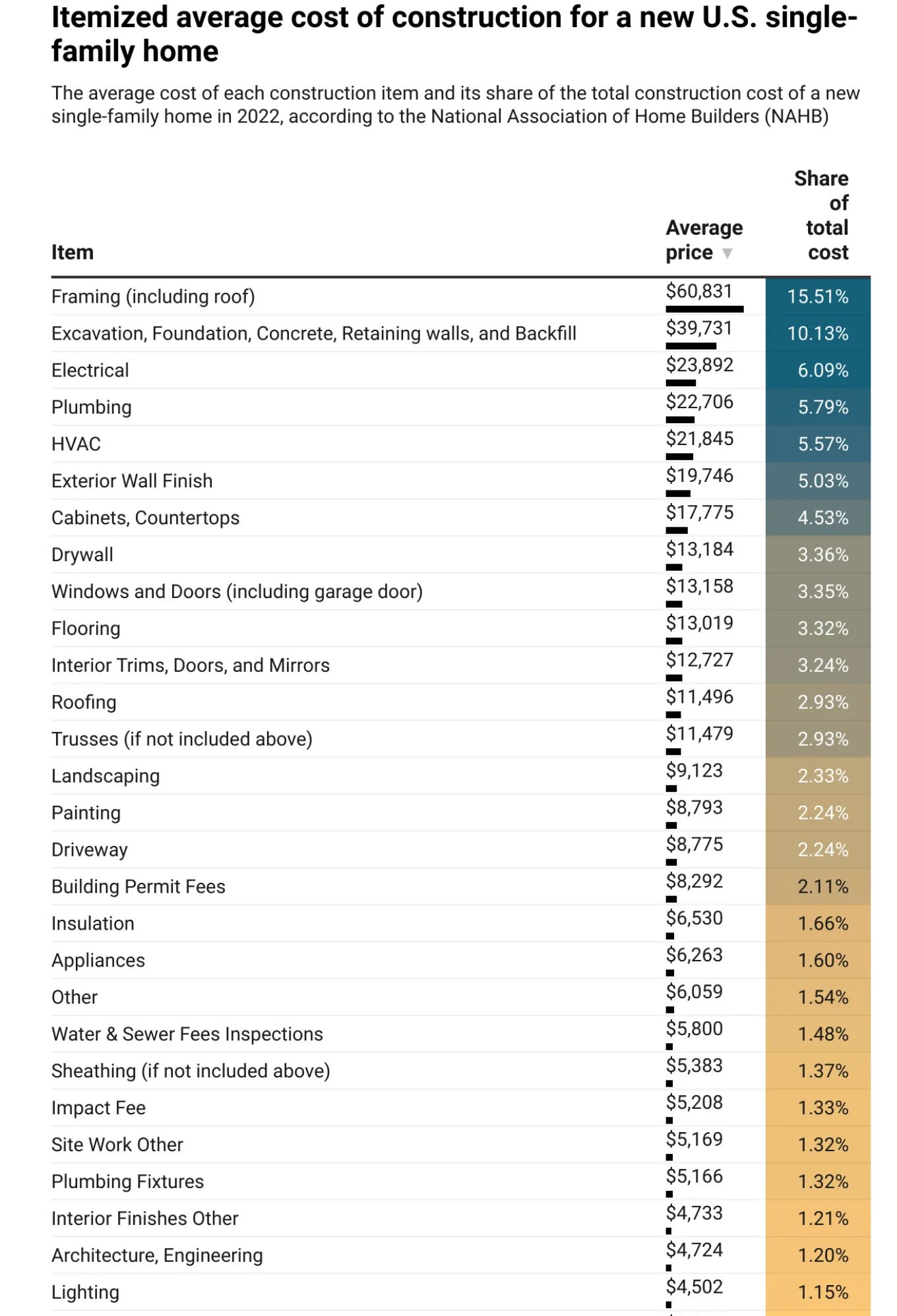
If we consider my own home, most of these items were not part of the original build and were still not part of the home even in the 1960s.
You can remove many of the major cost components that weren’t built—excavation, electrical, plumbing, HVAC, cabinets and countertops, landscaping, driveways and more. My rough numbers suggest we can remove enough items to reduce total costs by 50% and still have a home similar in size and quality to a mid-century detached home.
Here’s an example of why quality adjustment matters (put another way, quality has a quantity all of its own).
Imagine I have two detached homes of the same size. Back then the home was built productively, with 100sqm requiring only 1,000 hours of labour on site.
Now, the same size home requires 1,200 hours of site labour. When measuring productivity as “dwelling size per on-site labour hour” we see a decline of 16.6%. This would worry many people.
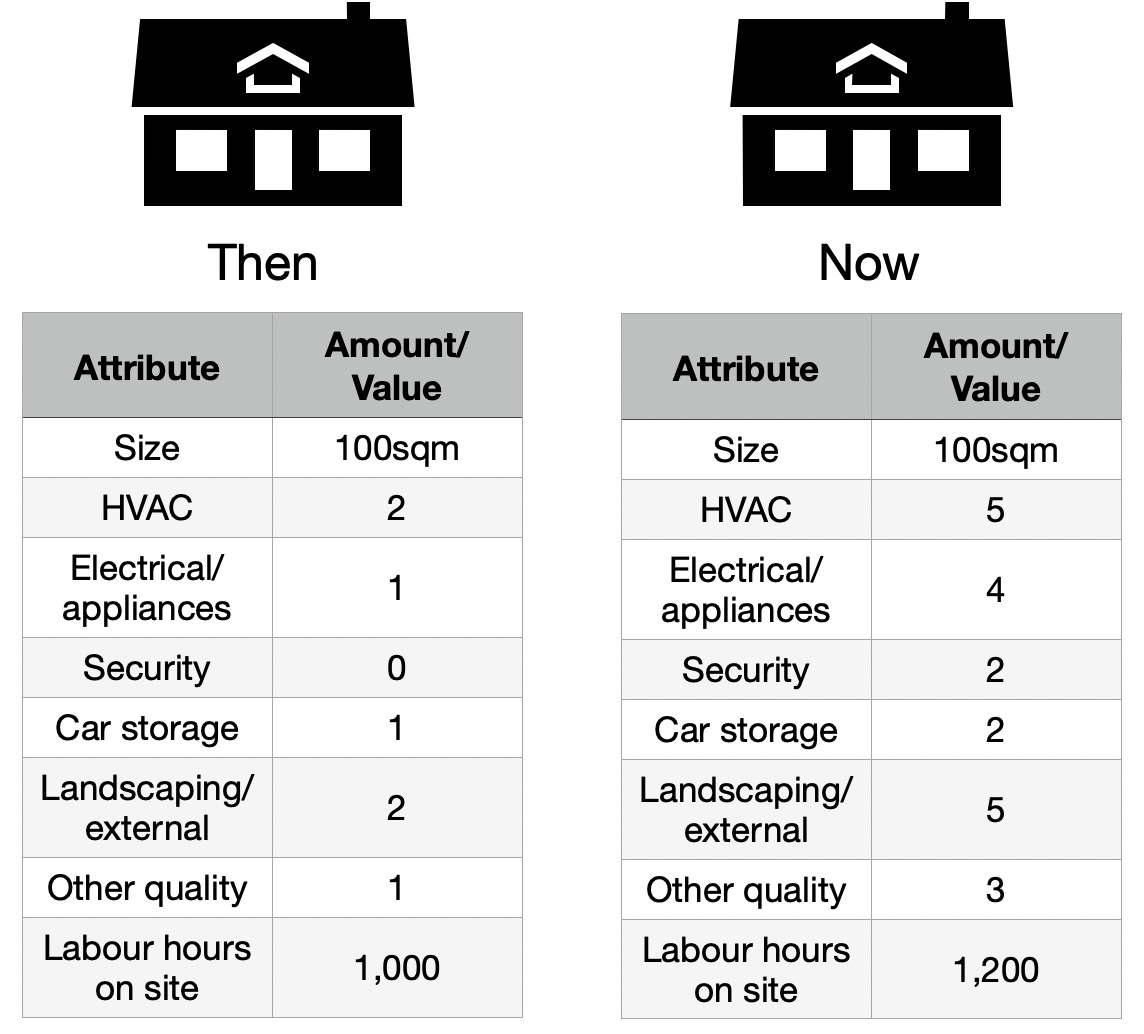
But look at the details. The list of attributes (aka items/characteristics/features) in each home is very different. If we measure the home by adding up the quantity of things we value, rather than the quantity of floor area, then we get a very different number.
If we add up all the amounts/values of each attribute the original home is a 7 and the new home is a 21. So each square meter of the new homes could be considered to be three times better. Adjusting for this quality change means we have the equivalent of 300 square meters of the old quality home in the new home of 100 square meters (quality is a quantity all of its own remember). Productivity on this adjusted basis has grown by 150%!
Alternatively, we could say that the same quality 100sqm home could be built today using just 800 labour hours of work on-site, but instead, people are choosing better homes that use more labour.
Even when we measure construction output by value rather than quantity, these composition issues arise.
Consider the situation of three men working for a week on-site to erect $50,000 worth of completed framing. These same three men can only complete $20,000 of site works and landscaping in a week simply because the tasks are qualitatively different, and require a very different share of material and labour inputs.
Meaning: What economics explains productivity?
In terms of what it all means, I would caution firstly that productivity changes don’t tell us about the value of the construction projects being undertaken. You can choose to invest in construction projects that use a lot of on-site labour and if the project has a high benefit-to-cost ratio, it is still a very positive investment to make relative to other uses of resources.
Measured productivity also rises and falls with the construction cycle, so we must be sure we aren’t confusing long-term structural changes with short-term cycles.
I find it useful to think of construction as mostly a service industry, not a manufacturing one. Labour is typically about half the total cost of construction (and of course producing materials uses labour indirectly too).
Why is that?
Complex tasks have to be undertaken to integrate materials that need to be packed for delivery to different locations for each build, which themselves have unique site constraints.
William Baumol famously noted that as a country gets richer, service industries don’t get cheaper because wages in these sectors rise with overall productivity, not sector-specific productivity. We call this observation Baumol’s Cost Disease, though it is just the observation about automatic macroeconomic adjustment to unequal productivity growth across economic sectors. Wikipedia mentions these patterns of adjustment are likely:
The share of total employment in sectors with high productivity growth decreases, while that of low productivity sectors increases.
Increasing costs in labour-intensive service industries are not necessarily a result of inefficiency.
These macroeconomic patterns seem to fit the construction sector of the economy too. I argue that this is the case because the construction sector is so large as to be its own macroeconomy. We should expect that as labour productivity improves in some parts of the construction industry fewer people will work in that part, and those productivity gains make us rich enough to spend more on other parts of the construction industry with lower labour productivity.
In other words, construction as a sector looks unproductive because when some parts of the sector become more labour-productive we tend to spend the cost savings generated to buy more parts of the sector that are less labour-productive.
That’s a lot to take in, so let me demonstrate using the figures in the below table from Brian Potter’s excellent Construction Physics site.
The important part of this table is the relative cost of materials and labour for different parts of a housing construction project.
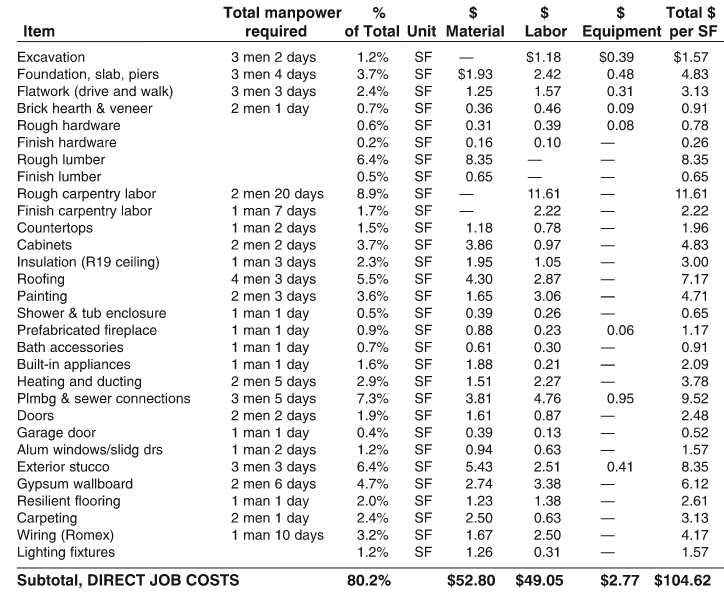
Notice that excavation has a high labour share of the total cost for that item (1.18/1.57=75%), as does heating and ducting (2.27/3.78=60%) and wiring (2.5/4.17=60%) and painting (3.07/4.71=65%). Other items have a low labour cost share, like carpeting (0.63/3.13=20%) and lighting fixtures (0.31/1.57=20%).
As labour can shift between tasks, assuming a constant number of hours per dollar of labour is a good approximation (i.e. the hourly rate of labour is fairly similar between jobs).
Since the value of the construction contract is related to costs, one way that on-site labour can increase relative to the value of output is by shifting the composition of items in construction projects towards those with higher labour shares of total cost.
Do more excavation, heating and ducting, wiring and painting, and less carpeting and lighting, and you can have the same value construction project with vastly different amounts of on-site labour and hence vastly different labour productivities.
For example, think of our $400,000 build value with $300,000 or direct job costs that use 1,000 man-hours (for the sake of round numbers) which comprise half the total cost. We have $4,000 of the market value of construction per on-site man-hour as our labour productivity metric.
Now, consider what happens when we build a different home with different features, and reallocate 25% of the input value from items where labour is 40% of the cost to items where labour is 60% of the cost. For example, more excavation, heating/cooling and wiring but fewer high-value appliances, carpets and light fixtures.
Three-quarters of the items in the job stay the same, so there is no change to the 750 man-hours for this unchanged portion of the total job.
For the 25% of items that changed, we increased our man hours by 50% from 250 hours to 375 hours for those items. This happens because the cost share of labour increased from 40% to 60% (so 50% more labour for the same dollar-value item).
Total man hours for the whole project increased by 125 to 1,125 even though the home has the same total construction value.
This different composition home with the construction cost and value has a labour productivity of $3,555 per man hour (which is $400,000/1,125) not $4,000 per man hour—an 11% decline.
As Baumol noted, this compositional change is what we would expect as we get more productive—we need fewer work hours from people on-site in high-productivity parts of the build and more workers onsite for lower-productivity parts. Overall, the ratio of total costs devoted to labour would stay relatively constant, just as it does in the macroeconomy as a whole.
You can still worry if you like
Construction is a sector large enough to see macroeconomic compositional shifts within it. We forget that.
And just like the macroeconomy, we should be concerned about fostering innovation and productivity wherever possible. So it’s okay to worry, just like we worry about better productivity in healthcare, education, agriculture, or mining.
But only if you have an informed economic view of what you are observing—both in terms of the measurement of productivity and its economic meaning.
As a final note, I thought I would share this photo of a Brisbane subdivision in the 1950s. Yes, those little sheds in the backyard are dunnies (toilets) with no plumbing.
Notice even here that so many items that are standard today in residential construction projects weren’t built, from garages and driveways to excavation and stormwater management to sewers, concrete slabs, indoor plumbing, sealed roads and more.
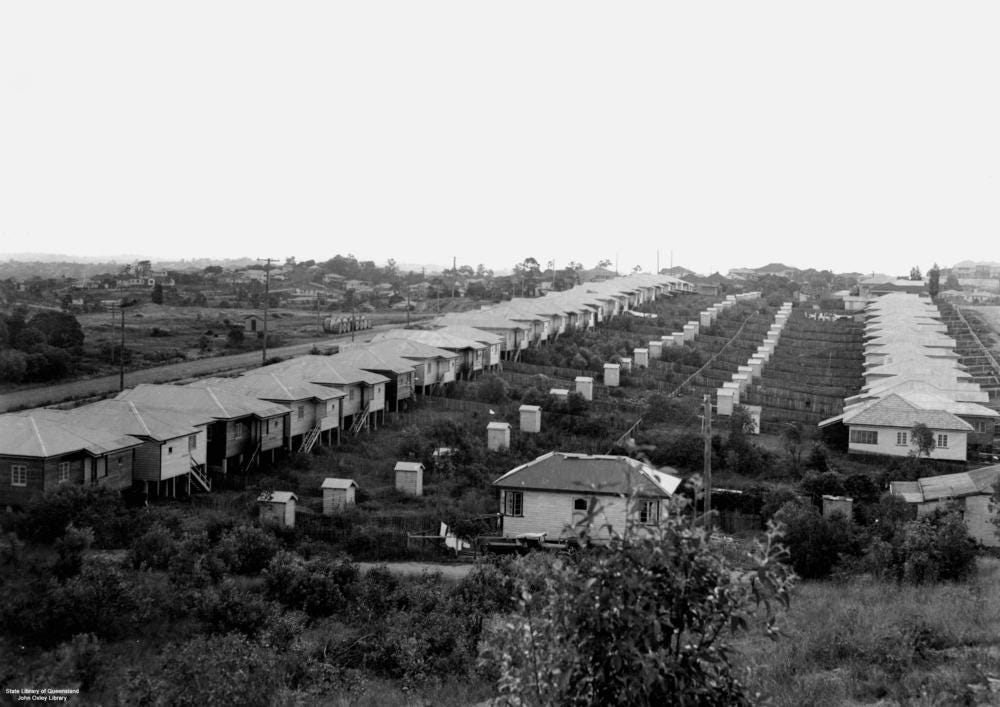
You could build this type of housing estate today and construction would be very cheap.
Why don’t we?
Because we are rich!
And it is because we are rich that we build much different homes than what we used to, requiring more manpower to construct all the low-productivity extras we want, and that makes construction sector productivity measurement difficult to untangle from larger macroeconomic trends.
Brisbane didn’t get sewers until the mid-20th century, and even in 1960 about half of homes had no sewer connection (people would dispose of human waste in buckets, which night soil men collected).
Many economic purists would argue that multi-factor productivity theoretically better measures the unexplained residual, or what we label technology or productivity. But that’s a story for another time.
I’m always very wary of statistics and the interpretations of them. Suspect I will be referencing this post. It really occurs to me that the cost of housing is made up of the costs of (1) approvals requirements (2) materials (3) labour (4) land - to oversimplify. Seems lately we have assumed that we cannot do anything about materials costs. Labour costs is difficult, and the ALP is a roadblock there, potentially rightly. Land is a cost, but with land prices rising between when developers buy land and sell the final product it cross-subsidises all other costs and therefore industry does not want to shine a light on this. Therefore, the only avenue they are willing to advocate for is ‘reducing red tape’. Seems like a lot of fervour.
Builders price home construction higher on costs quoted to capture anticipated capital gains as homes appreciate in value through subsequent sales?