


A lesson from the past few weeks of public debate in Australia is that even those who are most passionate about immigration don’t seem to understand how the design of the visa system affects Net Overseas Migration (NOM).
This Explainer is to help those who want to learn.
UPDATE: Try the FET Aussie NOM simulator spreadsheet

Ground Rules: Land and Housing Economics for Professionals
Don’t forget to put that professional development budget to work with upcoming FET workshops in Sydney and Melbourne.
These two-day workshops have been created for smart researchers, policy analysts, economists and planners to bring them up to speed with the economics of land and housing markets.
Sydney and Melbourne workshops: Land and Housing Economics for Professionals

This week, an announcement.
Migration’s big picture
Net Overseas Migration (NOM) is a term that describes the change in the number of residents in Australia due to international movements in and out of the country. A resident is someone who resides in the country for more than 12 months out of a 16-month period.1
This 12/16 rule is why the NOM data has a long delay—it takes a while to work out if a person stayed 12 out of 16 months to be a resident rather than a visitor. Only preliminary data using modelled estimates is released six months after the reference quarter, then final data arrives at least 16 months after the reference quarter (as explained here).
NOM includes: the change in the number of Australian citizens, as some return from living abroad and some depart; the change in the number of NZ citizens residing in Australia, who have free labour mobility; and the change in the stock of resident temporary and permanent visa holders.
NOM excludes short-term holiday-making and business travel, which is the bulk of the 1.6 million international arrivals (and departures) each month, as these do not change where a person is a resident.
The diagram below shows the buckets of the Australian resident population, to scale, and each bucket’s labelled flows in and out of the country (A to H) from international resident movements (i.e. excluding short-term visitors and holiday-makers). Also shown and labelled are paths I and J, which are temporary residents becoming permanent, and permanent becoming citizens, neither of which directly affect the NOM because these people are already residing in the country and merely swapping buckets.
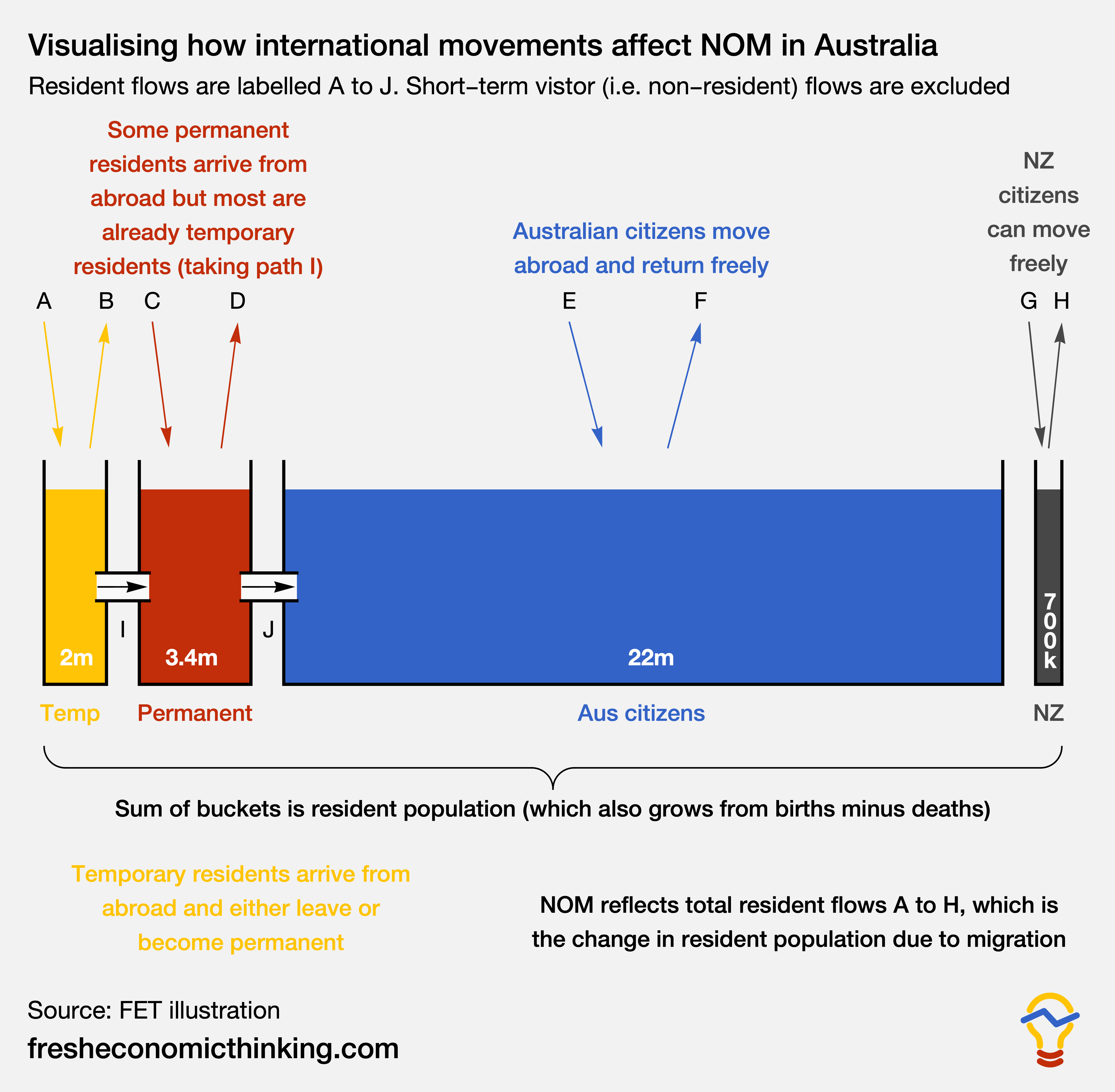
What sharp eyes might notice from this diagram is that we can’t directly regulate NOM to a fixed number if we want many of the potential international movements of residents (B, D, E, F, G, and H) to be freely chosen and unregulated by visa requirements. Few would argue that Australians leaving to live abroad and return to live at home should be restricted.
Instead, the rules of the temporary and permanent visa system can influence key resident flows like A, C and I, which can have the largest effects on NOM.
Another important point is that NOM depends on net flows of residents to each bucket rather than gross flows. For example, you can have very high flows of A and B into and out of the temporary visa stock of residents, but if these flows are equal, then they do not affect NOM. Only if there is a gap between the inflows and outflows, and hence a rising or falling stock of temporary residents, is there an effect on NOM.
It is underappreciated that the resident flows in and out of the country are much larger than the change in the stock of residents.
For example, 234,000 temporary student visas were issued to those outside Australia in calendar year 2025 (out of 371,000 altogether, including those issued onshore). Still, the stock of student visa holders residing in Australia fell from 522,000 to 477,000, or 45,000 during that calendar year because departures of student visa holders (or conversion onto another visa) were higher than the large in-flow of new temporary student visa holders.
Over the past decade, net flows into the temporary migrant bucket have increased NOM by around 100,000 per year out of a 250,000 per year average total NOM.2
The net flows of Australian and New Zealand citizens (E, F, G and H) are usually small, with an effect on NOM of less than 20,000 per year and sometimes a negative effect.
In total, the migrant inflows (A, C, E, and G) of those who stayed more than 12 out of 16 months over the past decade averaged 512,000 per year, while the migrant outflows (B, D, F and H) of those who remained abroad more than 12 out of 16 months averaged 262,000. This meant that NOM averaged 250,000 per year for the last decade (or 291,000 per year if we exclude the two COVID years of 2020 and 2021).
All of this is important context to help make clear the key message, which is that NOM can only be indirectly regulated using the temporary and permanent visa system to affect the flows A, B, C, and I, via
conditions and caps on the number of permanent visas issued annually (flows C and I), and
temporary visa conditions that affect the stock of temporary residents (flows B and A).
We can see how these four resident flows affect NOM mathematically:
For a long time, visa settings have been such that the temporary stock has increased because A has been higher than (B+I), while the permanent gross flow has been capped by annual permanent visa rules, setting an annual maximum of (C+I).
Let’s take a closer look.
Temporary resident stock
Data on temporary visa holders is here and downloadable below.
Most temporary visas are uncapped and issued based on compliance with each visa rule. This is called a demand-driven system. The number granted is only limited by compliance with the eligibility requirements of the available temporary visas and the administrative capacity of the Department of Home Affairs.
The largest increases in the stock of temporary visa holder residents in the past three years have been in bridging visa holders (up by 235,000), who were typically holders of other visas wishing to extend their stay rather than leave, and temporary graduates (up by 70,000), who have similarly switched from other temporary visas, in this case student visas.3 Over 100,000 per year of the NOM experienced in Australia from 2023-2026 was from a growing stock of residents in these two temporary visa categories alone.
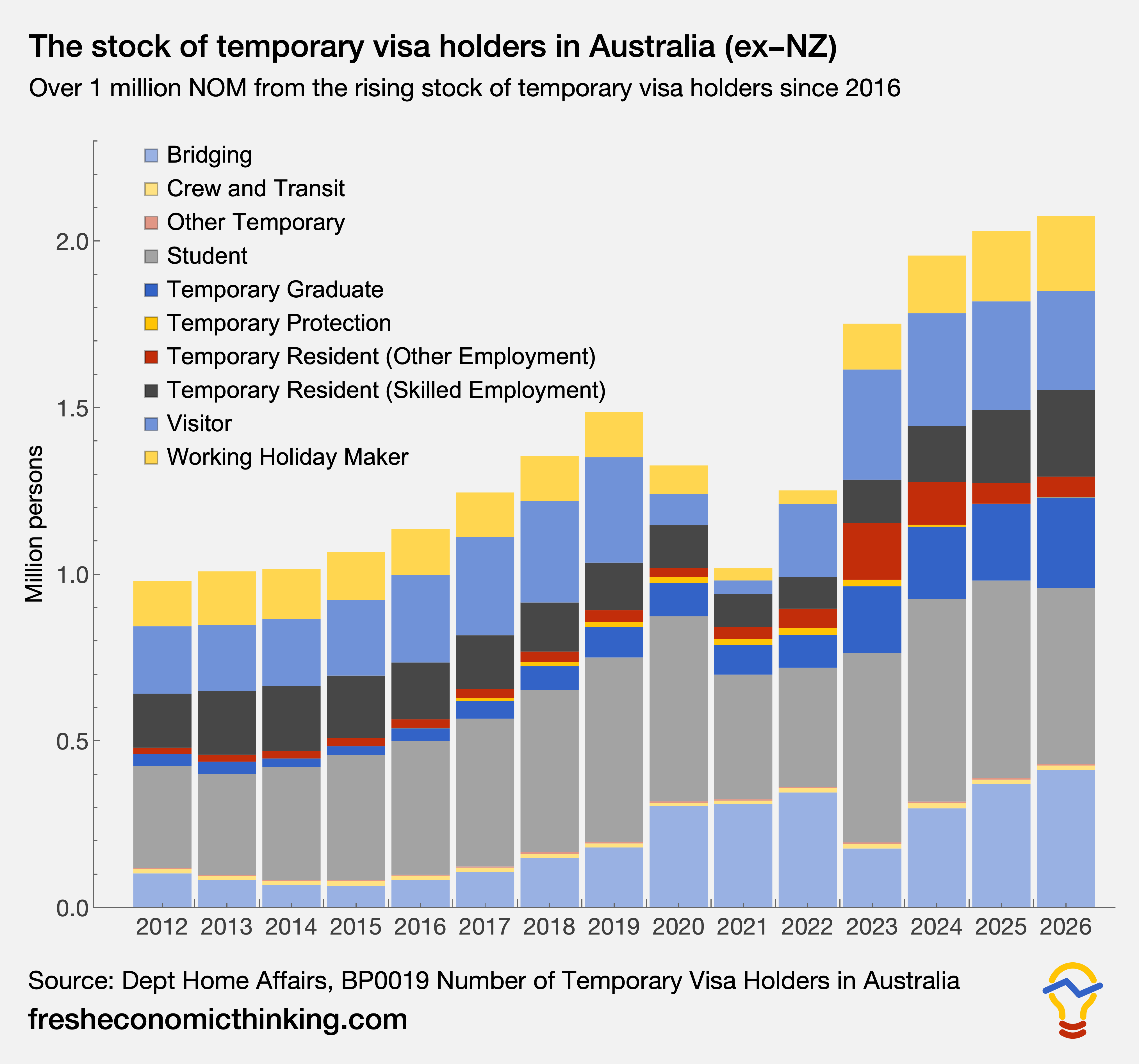
The temporary visa system allows for switching to other visas, which is a policy setting that can be changed to affect NOM via the net flow of temporary residents. Removing the options to stay on a different temporary visa will decrease NOM by increasing flow B, the temporary resident departures. There may also be a deterrent to flow A as future seekers of temporary visas realise that getting a temporary visa in Australia is far less likely to lead to long-term residency.
These dynamics are well known, which is why analysts from across the political spectrum propose tightening up these temporary settings to reduce the stock of temporary residents and reduce the visa swapping that has fostered a “permanently temporary” cohort of people.
Policy changes that would reduce the stock of temporary residents, thereby reducing NOM, might involve tightening student language standards for student visas, increasing income thresholds for temporary skilled workers, limiting secondary family visas for many temporary visa categories, and making bridging visas harder to get.
If the stock of temporary residents began falling because of tighter temporary visa settings, it would have a large temporary effect in reducing NOM. If, say, the stock of temporary residents fell by 500,000 over 5 years (from roughly 2 million today to 1.5 million in 2031), that would have a temporary negative effect of 100,000 per year on NOM.
This is a scenario playing out in Canada right now.
Visa rules were tightened there in 2025 with the intention of reducing the stock of temporary residents. As a result, Canada has seen negative population growth for three quarters in a row, with a negative change of 55,000 in population in the most recent quarter.
Their total population decline has been 234,000 in 9 months. This effect will be temporary, until such time as the stock of temporary residents stabilises at a lower number.
Permanent resident flow
The second major policy lever is the permanent visa program that predominantly issues family and skilled visas and has an annual cap, called a planning level. It is a long-standing policy to limit flows C and I via this planning level. For the 2026-27 financial year, that annual cap is 185,000 permanent visas.
Typically, most permanent visa holders come via flow I from temporary visa holders. As noted by the Department of Home Affairs, “In 2024–25, 61 per cent of permanent skilled visas and 39 per cent of permanent family visas were issued to people already onshore.”
Although these flows from temporary to permanent (flow I) do not directly affect NOM, they allow for temporary visa flows A to be above B by I before affecting NOM.
If the stock of temporary residents remains fixed, the permanent visa planning level is the main way that the visa system affects NOM.
There are a variety of sub-categories within the overarching skills and family streams of the permanent visa system. For example, a strange one that has been the subject of great debate is the 7,000 places (down from 8,000 last year) for parental visas, which allow citizens and permanent residents to bring their parents to Australia permanently.4 The demand is high for them, and the waiting period is now decades long. Should they even exist?
To use the permanent visa system to reduce NOM simply means reducing the planning level of some of these permanent visa categories, preferably starting with those known to be issued to fairly low-performing households, such as regional skills visas. Making income hurdles higher for some classes of skilled permanent visa might also better target those visas and reduce demand for them.
Such changes would reduce NOM long-term by reducing flows C and I, while immediately deterring some temporary inflows, A, because of the lower chance of permanency for some potential temporary migrants.
Back in 2004, for example, before the 2006 ramp-up to structurally higher immigration levels in Australia, the temporary resident stock was relatively stable, and the planning level for permanent migration was 120,000. That type of outcome could be achieved again without much difficulty.
Yes, the visa system is complex. But the right conceptual understanding can greatly simplify it and clarify how temporary and permanent visa policy changes will affect which new residents, and how many, come to Australia.

As always, please like, share, comment, and subscribe. Thanks for your support. You can find Fresh Economic Thinking on YouTube, Spotify, and Apple Podcasts.
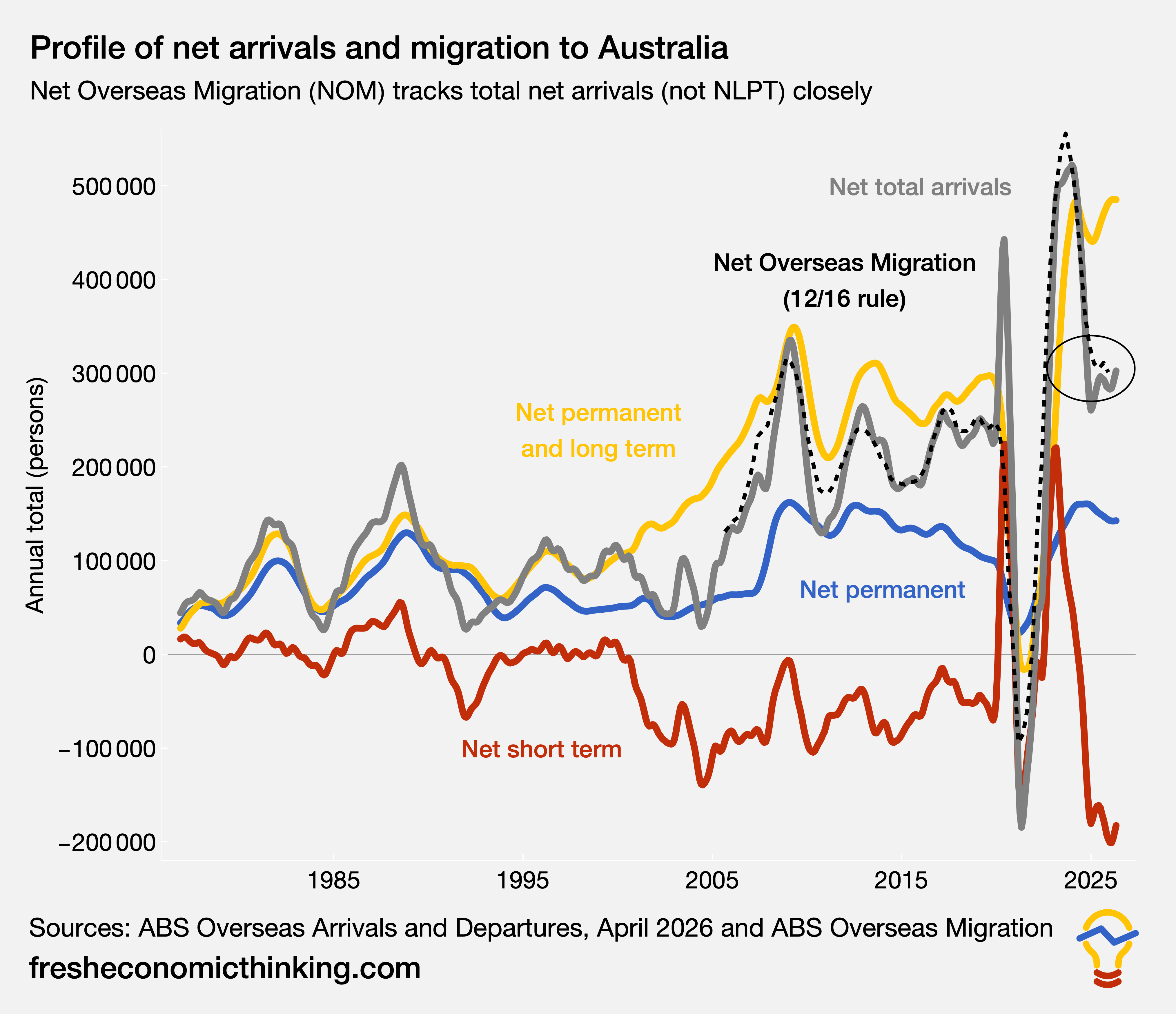
This 12/16 rule was established in the measurement of NOM in 2006, so comparability is not perfect before and after this date, though the close tracking of NOM using the 12/16 rule and the net arrivals data, shown in the chart below (dashed black NOM and grey net arrivals), suggests that there is not a major ongoing change as a result of this methodological change.
Excluding NZ residents. There are some added complexities around the NZ citizens, who generally get a subclass 444 temporary visa on arrival, and who have pathways to Australian citizenship that were recently changed.
One feature of most visa sub-classes in both the temporary and permanent visa system is that visa categories apply to family units, not individuals. So a skilled temporary work visa will go to the person being sponsored for work (a primary visa), but a skilled temporary work visa will also go to their spouse and children (they will get secondary skilled visas).
With the permanent parental visa system two further classes: contributory, which pay a large fee of about $50,000 and non-contributory, which do not.
Permanent visa applicants are required to undergo a medical examination with a registered 'panel physician' or 'commonwealth medical officer'. Temporary spouse visa applicants are also required to undergo medical tests. (they want to medically test your foreign spouses and children, whether or not you intend to reside in Australia).
The medical exams includes a chest x-ray 'to test for TB'. Current NICE guidelines only indicate that chest x-rays are to be used in monitoring TB treatment - for over a decade, if not more, blood tests or skin tests are considered the accurate testing for TB. Blood is taken at the visa medical exams for HIV and other (unknown to the applicant, so a bit spooky really) tests, so the x-ray seems v. unnecessary. Temporary visitors self-certify that they are free from TB on arrival cards.
Fees for these services are paid by the applicants to the medical examiners. These medical examiners advise Home Affairs on the testing regime, ie. that the chest x-rays are required. The fees are around market rate, but as interest rates rise, the value of the immediate cash from the applicants (as opposed to waiting for a claim to an insurer or the state medical service for overflow management), increases to these examiners. Little incentive to reduce the testing per patient revenues flowing in.
Even if you meet the medical requirement, if the Department delays decision for more than 18 months, they require you do do new medical exams.
The mates at it again, I reckon
Fun fact - Australian Border Force is one of the few current Public Sector Paramilitary in Wikipedia:
https://en.wikipedia.org/wiki/Paramilitary
(correction, sorry, I hit P sometimes and fingers take over Public / Private)