


The Future of Affordable Housing - online webinar
Housing affordability and construction productivity are two of the most debated topics in our industry today. But are we missing some fundamentals?

I will be speaking at this event about fundamental economic issues in our understanding of construction productivity and its apparent decline.
Book here. Use code LAW15 for a 15% FET supporter discount.
Dates: Friday, October 2, 2026 & Friday, October 9, 2026
Times: 4.00PM - 6.30PM
CPD hours: 5 (5 formal points)
Speakers: Cameron Murray, Fresh Economic Thinking; Noura Thaha, Associate Principal, Group GSA; Stephen White, Director Planning Urbis; Lindsay Clare, Clare Design; Kim Houghton, Economic Solutions (Regional Housing Issues in Australia); Geoff Hanmer, Architect & Lecturer at UTS; John Baker, Founding Director, BKA Architecture
Brisbane’s planning system was recently criticised for its character protections. This article noted that “heritage laws enforced by city councils can frequently deny cost-effective new builds and renovations.”
Below is a screenshot of that article with the image of an old house on a steel frame during construction. The image seemed to trigger strong reactions from many people.
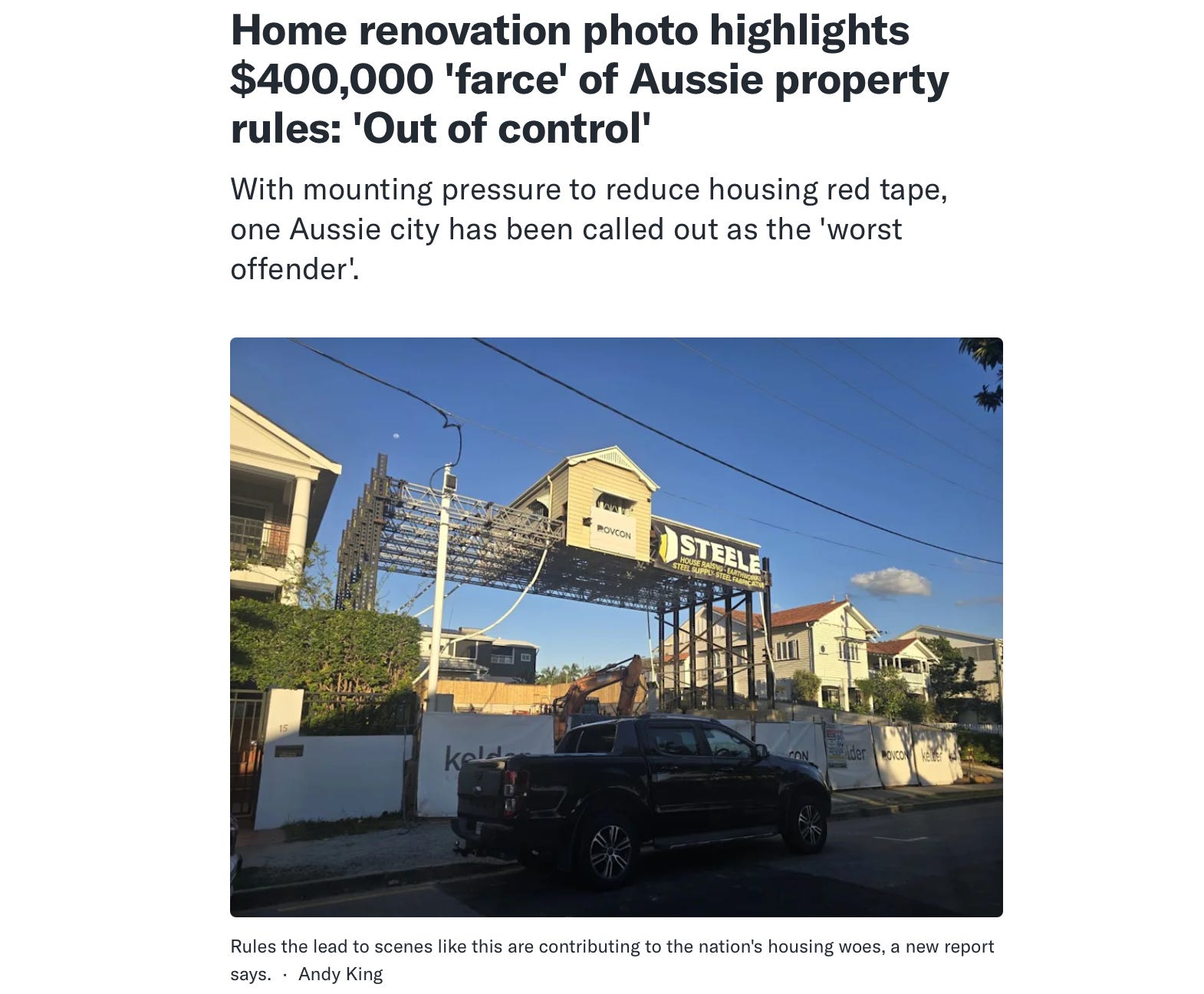
The issue of concern was that Brisbane’s character protection rules prevent demolition of pre-1947 housing, but allow for these homes to be preserved and incorporated into new development. This is why the old house is perched on a high steel frame—to be preserved and incorporated into the new build.
The apparently newsworthy angle is that a neighbour of this project, Andy King, who is a quantity surveyor, doesn’t like the rule. He said:
I'm so against these renovations… where you lift up these boxes, and then you gotta try and incorporate that into a new build. It would easily add probably $400,000.
It turns out that this all stems from that neighbour’s prior experience of failing to understand planning rules.
King had his first experience with the laws more than a decade ago when he bought a pre-1947 family home which had a demolition approval on it at the time, but was due to expire not long after the sale.
“I knew nothing about this stuff at the time. I rang council to say, ‘Hey, what do I need to do to extend this?’
“And they never got back to me… I thought nothing of it. I thought if they’ve given it once, they’ll give it again, how hard could it be?
“Biggest mistake of my life,” he said.
King ultimately ended up in years-long battle with the Brisbane City Council which eventually conceded the day before trial and granted the permission he was seeking to build a new home.
Is it news that he knew nothing about the rules before trying to embark on a project a decade ago and is now upset that a neighbour is complying with the rules?
I’m so confused.
The beat-up is admitted later in the article when we find out that the renovation is for a luxury mansion with a market price that I would estimate to be above $10 million.
…the owners probably weren't too miffed by the extra expense of incorporating the historical facade into the renovation given the site is slated for a stunning, luxurious three storey mansion with a pool, gym and underground garage that can fit 10 cars.
Here are some architectural designs for those interested.
Why do these character protections exist?
This is a valid question. They exist because people value them.
They exist for the same reason that a developer will enforce strict covenants about what building designs are allowed in their new housing estates.
We need a mechanism to get people to precommit to preserving the collective environment and not shirk their responsibility by defecting and building something ugly for a quick buck on their lot.
People want their city to look and feel like their city, with its own history. Developers want their estates to look and feel like their estates.
Defecting and building ugly stuff happens. And people hate it. The tweet below shows such an example.


Rather than judge every project in some kind of beauty pageant to make sure it fits with the collective expectations, we make rules that precommit every property owner to a certain standard.
Brisbane’s character protections are one such standard. They require that pre-1947 homes be preserved and incorporated into new development in most residential areas.
These character protections have been an effective planning rule that has allowed flexibility in new project design, while maintaining the distinct and recognisable character of the older suburbs. Many character areas still get developed with townhouses out the back, homes slid sideways to split blocks, and character homes incorporated into larger and denser projects. While all this happens, a visual history of the neighbourhood from the perspective of the street is preserved.
These are good and desirable outcomes.
The only strange part is that, despite operating for many decades, there remains a misconception about the effect of character protection and heritage rules on development.
Heritage and character protection rules usually don’t prevent development, but merely require designs to work around heritage features at a site.
Here are a few examples from my neighbourhood.
Below is an image of a new apartment tower on the site of the heritage-listed Skyneedle, where the “design of the development has been tailored around the Skyneedle to ensure it is the hero feature of the new complex.”

Here is another, where the heritage-listed Peters Ice-Cream factory was incorporated into a massive shopping complex and residential tower complex at West Village.

The Queen’s Wharf casino project is one of Brisbane’s biggest recent CBD projects, which was designed around a variety of heritage buildings and site features to create a genuinely good design outcome.1

We of course should have a conversation about what heritage we value, and whether the rules allow for preservation in a reasonable way.
But from where I sit, Brisbane’s character protections and much of its heritage system are working as intended. They appear to be effective planning rules that allow for development while preserving neighbourhood character that people actually value.
I suspect people are confused about what planning rules do and how they function because of the uninformed news reporting, as we saw earlier. More than that, there are many interest groups who like to point to these rules as the cause of the price of homes, because they might stand to individually benefit from changing them.
Read more about that in my book The Great Housing Hijack.
Put Fresh Economic Thinking to work
Why a paid subscription matters
A paid subscriber to FET wants intellectual challenge. They don’t want someone to write what they already think. They want insights that are hard to get elsewhere and a public debate that is intellectually honest, not tribal.
Subscribing is a vote for independence — you're saying I want Cameron Murray to have the financial freedom to investigate things that other economists won’t investigate.
If that sounds like you, and you get value from the research and analysis published here, I’d appreciate your financial support.
A fresh economic consultancy
Most economic consultancies begin with the conclusion a client wants. They sell institutional credibility and a report. I sell economic thinking.
If your organisation has a difficult economic question, a policy argument that needs testing, or a problem where you want to get beyond the usual consultant consensus, I’d like to hear from you.
FET also provides custom economics training, presentations and workshops for organisations that want their people to understand the economics behind the issues they work on.
If there are economic concepts, debates, or blind spots your team needs a genuine handle on, then please reach out.
Ground Rules: Land and Housing Economics for Professionals
Put that professional development budget to work with an upcoming FET Land and Housing Economics workshop in Sydney or Melbourne.
This two-day workshop is crafted for smart researchers, policy analysts, economists and planners who want to truly understand how land and housing markets work.
If you are a town planner or architect, this course may be eligible for CPD points from your professional Institute.
Sydney tickets here.
Melbourne tickets here

More details here.
As always, please like, share, comment, and subscribe. Thanks for your support. You can find Fresh Economic Thinking on YouTube, Spotify, and Apple Podcasts.
These are some of the densest housing and development projects in Brisbane, but are mapped as “restricted” by a recently popular Zoning Atlas mapping tool.